Showing posts with label President Barack Obama. Show all posts

Saturday, November 5, 2011

US official: ‘India's rise will reshape global system’

Noting that "India's rise will reshape the international system", a top US official has said that Washington seeks a 21st century Asia-Pacific in which India, the US and China all enjoy good relations.

"To paraphrase India's National Security Advisor, I have no doubt that Asia and the world are big enough for the three of us - if we want them to be," Deputy Secretary William Burns said outlining US Strategy for the Asia-Pacific on Friday.

"Soon to be the world's most populous country, and already the world's biggest democracy, with an economy likely to be the world's third largest within two decades, India's rise will reshape the international system," he said at World Affairs Councils of America National Conference here.

Noting that President Barack Obama has stated that India will be "one of the defining partnerships of the 21st century," he said: "We also want it to be one of the defining partnerships in the Asia-Pacific."

"India is already a powerful economic and cultural presence in East Asia, and has built a vast network of economic agreements and security arrangements with partners like Japan, South Korea, Australia, Singapore, Indonesia, and Vietnam," Burns said.

India's outreach is growing toward a comprehensive vision for the East Asia region-a "Look East" policy that is becoming an "Act East" policy, he said.

"That's why, last year, our two countries launched a strategic dialogue on the Asia-Pacific to ensure that the world's two largest democracies pursue strategies that reinforce one another," Burns said.

Hoping that India will join the US in working to strengthen Asia's many regional institutions, he said: "An architecture of free trade and investment that connects India to Southeast and East Asia will have a profound impact on global trade and economic growth."

Saturday, September 24, 2011

Japan will not turn inward after disaster: PM Yoshihiko Noda

Prime Minister Yoshihiko Noda said Friday that Japan will step up its contributions to the international community rather than "turn inward" after the devastating quake and tsunami that struck in March.

Noda said Japan could take the lead in improving nuclear safety around the world by quickly and accurately sharing what it learned from the accident at the Fukushima Dai-ichi power plant triggered by the disaster - the worst radiation leak since Chernobyl.

He also promised to provide nation-building assistance in newly independent South Sudan, aid to the drought-hit Horn of Africa and to support democratization in the Middle East and North Africa. He offered a $1 billion loan for infrastructure and industrial development in that region.

"Japan is faced with numerous challenges but instead of turning inward ... Japan is intent on making better contributions to the international community and to continue its contributions to achieve a better future for the entire world," Noda told a news conference.

Noda took office three weeks ago, becoming Japan's sixth prime minister in five years. The former finance minister faces formidable challenges: reversing more than a decade of economic malaise, a crushing national debt and recovery from the quake that left more than 20,000 dead or missing and a reconstruction bill running into hundreds of billons of dollars.

Noda made his first trip abroad as prime minister to attend the UN General Assembly opening session which he addressed Friday. He met on the sidelines Wednesday with President Barack Obama.

Noda is viewed as strongly pro-US, and he described that alliance as the "lynchpin" of Japanese diplomacy.

But he also said Friday he would seek to deepen ties with China, Japan's larger neighbor which recently eclipsed it as the world's second largest economy.

Relations have long been strained between the two Asian powers. Animosity lingers over Japan's often brutal World War II-era occupation of China. Tensions flared last summer after a confrontation near disputed, Japanese-controlled islands between a Chinese fishing boat and a Japanese patrol vessel.

Noda said because problems sometimes occur between the two countries, it was important to promote relations so they can ride through the rough patches. He said he wanted to take up an invitation to visit China extended to him by Premier Wen Jiabao.

Monday, September 19, 2011

Obama plans taxes and spending cuts to reduce deficit

President Barack Obama is to unveil plans to cut the US deficit by $3 trillion (£1.9tn) over the next decade.

A White House official said his proposals include an overhaul of the tax code that would raise $1.5tn.

The official said the president would not agree to cuts in health care for the elderly if there were no provisions for rich Americans to pay more tax.

Republicans in Congress have already said they will not agree to any plans to increase taxes.

Mr Obama's plans include nearly $250bn in cuts on Medicare spending - the health care programme for the elderly.

"He will veto any bill that takes one dime from the Medicare benefits seniors rely on without asking the wealthiest Americans and biggest corporations to pay their fair share," Reuters quoted an Obama administration official as saying.

The president is scheduled to announce his long-term deficit reduction plan at the White House at 10:30 (14:30 GMT) on Monday.
Closing loopholes

Over the weekend, officials have been providing journalists with a preview of what the president's plan includes.

On Saturday, officials said Mr Obama wanted a "Buffett Rule" that would see Americans who earn more than $1m pay the same rate of tax as those who earn less.

The proposal refers to the billionaire financier Warren Buffett who has complained that he and his wealthy peers pay relatively less tax than the people who work for them.

Many high-income Americans benefit from tax loopholes that see earnings on investment taxed at lower rates than wages.

The US economy has been growing only slowly while the unemployment rate remains stubbornly high, above 9%. Facing an election next year, Mr Obama has had a battle in Congress over how to reduce the ballooning deficit while the economy remains stagnant.

A Congressional "supercommittee" of six Republicans and six Democrats has been charged with finding $1.5trn in deficit cuts by late November, when automatic cuts come into force.

Ratings agency Standard and Poor's cut the US AAA rating in August after the country went to the brink of a default over an extended battle in Congress over raising the government's debt limit.

Thursday, September 15, 2011

US to build ties with India in EA Summit

Aiming to build ties with emerging countries like India and Indonesia, President Barack Obama will attend the East Asia Summit in November, an Obama administration official said. "There are many aspects of our strategy of greater commitment to institutions like the East Asia Summit, President Obama will make his first appearance as US President in November, building ties with emerging states like India and Indonesia, obviously dealing with the extraordinarily complex set of relationships with a country like China," a senior State Department official said. "But at the top of the list is our relationship with our partners and our allies.

We have five treaty allies in Asia – Japan, South Korea, Australia, the Philippines, and Thailand," the official told reporters travelling with the Secretary of State Hillary Clinton enroute to San Francisco to attend the US-Australian Ministerial, better known as the AUSMIN followed by the APEC Women And The Economy summit. He said, over the last seven years, there was already a very strong relationship between Australia and the US, it has become even stronger. "We are working on a variety of things that we'll be discussing over the next couple of days.

We are going to talk directly about how US and Australian forces can operate closely together, can work together in a variety of ways, and to see how Australia can play a role in what is termed the Global Posture Review," the official said. Referring to the relationship between the US and Australia, the official said more recently, their discussions and focus of cooperation has got much further afield.


"We worked very closely on China with Prime Minister Rudd and, who now is Foreign Minister, is probably more than any other leader has just a remarkable command of China, has lectured in Chinese universities in Chinese, and has provided us his expert advice and commentary about how to proceed," he said. "We have worked with Australia on architecture and on trade. Architects in Australia have given us enormously good advice about how to position ourselves in this critical period on Asia. And as importantly, we have worked in what we might call out-of-area pursuits," he said.

"Australia's been enormously helpful in Afghanistan and in efforts on Pakistan. And more recently, Foreign Minister Rudd has been deeply engaged in a variety of efforts associated with supporting the Arab Spring both through bringing together other likeminded nations and also coordinating closely with the US," the official said.

Monday, August 29, 2011

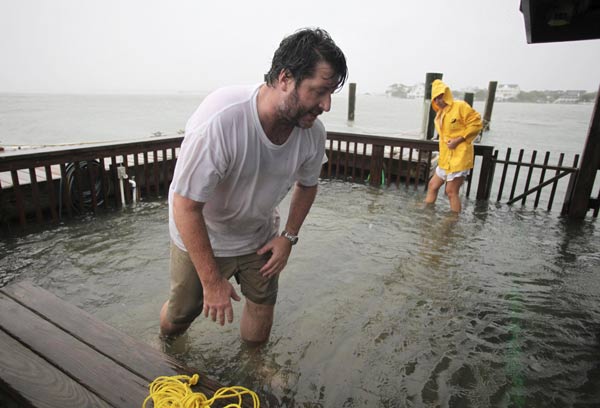
Hurricane Irene kills 18, impacts millions in US

ne Irene petered out leaving 18 dead across seven states and impacting millions with strong winds and drenching rains, authorities prepared to fight dangerous, damaging flood waters along the East Coast.

By 8 p.m., Tropical Storm Irene had maximum sustained winds of 50 mph and was nearing the US-Canadian border, according to the National Hurricane Centre.

The cost from wind damage alone is expected to top $1 billion, with downed power lines leaving more than four million people without electricity, according to US government estimates.

'I want people to understand that this is not over,' President Barack Obama said Sunday evening from Washington. 'The impacts of this storm will be felt for some time, and the recovery effort will last for weeks or longer.'

Flood warnings and watches were in effect Sunday night for much of New Jersey, Pennsylvania, eastern New York, Connecticut, Massachusetts, Vermont, New Hampshire and Maine.

Also hard-hit was New Jersey, where initial fears about coastal flooding -- which had prompted the evacuation of more than 1 million people from the shore -- had given way to fresh concerns about inland flooding.

In New York City, officials worked Sunday night to return the city to normal. Hours earlier, the Hudson River overflowed in lower Manhattan, receding only after massive amounts of water spilled over jogging paths and into at least one nearby apartment building.

Area's three major airports -- Newark Liberty in northern New Jersey and LaGuardia and John F. Kennedy in the New York City boroughs of Queens -- will reopen Monday, two days after they shut down.

New Jersey Transit rail service is suspended 'until further notice,' except for the Atlantic City rail line, but light rail and bus service will resume Monday.

Friday, August 5, 2011

Obama Celebrates 50th Birthday at White House

President Barack Obama marked his 50th birthday at the White House on Thursday. It was the second day of celebrations for the president. 

Mr. Obama’s birthday celebrations started on Wednesday night in his home city of Chicago, with about 2,400 people attending a fundraising event for his 2012 reelection campaign.

Obama was born on Aug. 4, 1961, and he is turning 50 Thursday. Some friends and family are coming to celebrate his birthday from hometown Chicago. According to the White House, his mother in law Marian Robbinson and family friend Kaye Willington flew in with him Wednesday night aboard Air Force One from Chicago.
 
President Obama said, “I could not have a better early birthday present than spending tonight with all of you, I love you back! "

Supporters at the event were treated to music by jazz legend Herbie Hancock and singer Jennifer Hudson.

Those who paid almost $36,000 for the most expensive tickets were invited to a small, private dinner with the president.

Mr. Obama has been facing his milestone birthday with a sense of humor.  He told the crowd that as he gets older, he is paying more attention to social welfare programs for the elderly.

“And it is true that I turn 50 tomorrow, which means that by the time I wake up, I will have an email from AARP, asking me to call President Obama and tell him to protect Medicare," said Obama."

Joining the powerful senior citizens’ lobby AARP is almost a rite of passage for many Americans as they turn 50.

Mr. Obama is the fifth-youngest of the 44 U.S. presidents, and the seventh to celebrate his 50th birthday while in office.  Bill Clinton was the last, in 1996.
Days after solving the debt ceiling crisis, the Obama campaign has been using his birthday to garner support.

World Market Rout is not Loud : Confidence Vote in Leaders

Global markets have issued a vote of no confidence in the management of the world’s two largest economies, the U.S. and the euro area. To regain credibility, leaders on both sides of the Atlantic need to recognize the magnitude of the crisis they face.

The outlook reflected by the market rout is not encouraging, coming as it does after European and U.S. officials thought they were doing enough to fix their similar -- and overlapping -- fiscal problems.

This week’s deal to raise the U.S. debt ceiling is a case in point. Given the exceedingly weak recovery, the U.S. government should stand ready to provide more stimulus. To prevent larger deficits from harming its credit standing, the U.S. must also convince investors that it is capable of putting its long-term finances on a sustainable path.

The deal that Congress and the White House ultimately struck doesn’t come close to solving the government’s long-term problems, but threatens spending cuts that could weigh heavily on economic growth in the short term.

Thursday’s moves in the markets gave a taste of how costly politicians’ dithering can be. The drop in world stock markets represents hundreds of billions of dollars in lost value. Italy’s cost of borrowing, as measured by the yield on its 10- year government bond, rose to a new euro-era high of 6.18 percent.

 Europe’s leaders should demonstrate that they stand together, ready to do what it takes to restore confidence. This would involve issuing jointly backed euro bonds to replace most or all of the debts of struggling governments.

In the U.S., the government must be prepared to boost consumer demand, and that means putting people back to work. Ideally, a comprehensive plan to fix the country’s long-term finances could be combined with a shorter-term stimulus. President Barack Obama is already promising to pivot from debt talks to a national jobs program. But having just completed punishing negotiations over spending cuts, he has very little hope of finding new money -- and little time to waste.

Barring a major new stimulus program, some steps can be taken. Obama could ask Congress to quickly adopt a jobs tax credit, renew clean energy tax breaks and temporarily waive federal environmental, labor and other requirements that delay public works programs, all moves that would put workers back on private payrolls.

When the Federal Reserve meets on Aug. 9, it should signal that it’s ready to do its part, too. Among the stimulative tools at its disposal: Pledging to hold onto the U.S. Treasury bonds it has accumulated in its quantitative-easing programs, and to reinvest the proceeds from any maturing securities in government debt. It could announce that it plans to keep its key interest rate near zero for a longer, more defined period. It could lower the 0.25 percent interest rate it pays banks that park excess reserves at the central bank, to prompt more lending and investing. And it could replace the shorter-term securities it holds on its $2.9 trillion balance sheet with longer-term ones, to push down those rates as well.

Ultimately, markets may force politicians and policy makers to implement all these measures and more. The world will be much better off if they find the will to get ahead of the curve.

Monday, August 1, 2011

Nikkei climbs on US debt deal, banks rise

The Nikkei stock average climbed back above 10,000 at one point on today, the first time in three days,after U.S. President Barack Obama said congressional leaders had reached an agreement to lift the U.S. debt ceiling, which triggered a broad-based market rally led by financial institutions such as Mitsubishi UFJ Financial Group.

The Nikkei Stock Average rose 131.98 points, or 1.3%, to 9965.01 following Friday's 0.7% slide. It was the sharpest percentage point gain for the index since June 29, and helped erase a portion of last week's 3.0% fall.

The Topix index of all Tokyo Stock Exchange First Section issues also added 10.33 points, or 1.2%, to 851.70, with all 33 subindexes ending in negative territory.

Stocks opened higher, largely on expectations for a conclusion to stalled U.S. negotiations on raising the nation's debt ceiling. Obama's confirmation of a long-awaited deal sent stock prices even higher, and the Nikkei subsequently topped the 10,000 mark. Liberal profit-taking soon kicked in, however, erasing some of the gains by the end of the day.

"We don't know yet how the ratings agencies will respond to the U.S. debt agreement," said Yutaka Yoshii, general manager at Mito Securities. "Once the initial market enthusiasm dies down, there is a possibility that investors will once again focus on the weaker-than-expected U.S. GDP figures."

The end to the often rancorous standoff in Washington, however, was a salve for banks, which between them hold large troves of U.S. Treasury bonds. Mitsubishi UFJ Financial Group rose 4.1% at Y408, while Sumitomo Mitsui Financial Group also added 2.9% at Y2,905. The pair were aided by solid quarterly earnings results delivered last Friday; MUFG posted a record group net profit for the period ending June 30. Mizuho FG also rose 2.4% to Y130.

Among other earnings-oriented shares, NTT Docomo rose 1.6% to Y143,800 following solid first quarter results showing a net on-year profit rise of 12% thanks to an increase in smartphone users.

"We now see the possibility of management issuing a guidance hike in the second quarter," Deutsche Securities analyst Yoshio Ando wrote in a client note, adding that smartphone sales and revenue trends for users shifting to smartphones have been strong.

Easing concerns over U.S. debt problems helped factory automation machine manufacturer Fanuc hit an all-time high of Y15,420 intraday as investors targeted so-called "economy-sensitive" stocks. Fanuc closed up 4.6% at Y15,280. Fast Retailing also hit a 2011 high before ending up 2.4% at Y14,010.