Showing posts with label India. Show all posts

Tuesday, November 22, 2011

Subhash Chandra wins International Emmy award

Subhash Chandra, the Founder of Zee Group— India’s first Hindi satellite channel, on Monday night received the 2011 International Emmy Directorate Award.

Mr Chandra made history by becoming the first ever Directorate Award recipient from India.  The award was presented at 39th International Emmy Awards, which took place on Monday, November 21st at the Hilton New York in New York City.

“Subhash Chandra is a one of a kind visionary- a self-made entrepreneur who made his mark on the Indian television industry by launching the first privately-owned channel in India,” said Bruce Paisner, President & CEO of The International Academy of Television Arts & Sciences. “We look forward to presenting him with our 2011 International Emmy Directorate Award as Zee Entertainment Enterprises prepares to celebrate its 20th anniversary, in 2012.”

Remarked Mr. Chandra, “India is the cynosure of the world today and it’s a great privilege to be the first Indian recipient of this award. It really means a lot to me, Zee Group and the Indian media and entertainment Industry.”  He added, “While there have been many representations from India in the areas of technology and retail, this puts India’s media industry on the map and raises the profile of India with regards to its media and content.”

Richard Parsons, Citigroup chairman and former chairman and CEO of Time Warner, along with Emmy Award-winning actress Archie Panjabi (CBS Network’s critically acclaimed hit drama “The Good Wife”) present the International Emmy Directorate Award to Mr. Chandra during The International Emmy Awards Gala.

The 39th International Emmy Awards were hosted by Jason Priestley, who was joined on stage by a cast of international celebrity presenters. Actor, director and producer, Mr. Priestley (Call Me Fitz, Bag of Bones, Beverly Hills 90210) was hosting for the second consecutive year. He was be joined on stage by Mr. Parsons, Ms. Panjabi and a cast of presenters including, Brazilian actor Vladimir Brichta, Jeff Hephner (Starz’ Boss), Edward Herrmann (Gilmore Girls), Rick Hoffmann (USA Network’s Suits); John Larroquette, Danny Pino (NBC’s Law & Order: Special Victims Unit), Ally Sheedy, Blanca Soto (Univision’s Eva Luna and El Talismán), Jessica Szohr (Gossip Girl); Wendy Williams (host of syndicated talk show The Wendy Williams Show) and Goku and Luffy (characters from Toei Animation’s animated hit Dragon Ball Z and One Piece).

The International Emmy Awards recognize excellence in television programming produced outside of the United States. 1,000 international entertainment decision-makers from over 50 countries attend the International Emmy Awards Gala in New York every year.

Tuesday, November 15, 2011

N-capable Agni-II ‘Prime’ successfully test-fired

India successfully test-fired Agni-II prime ballistic missile from Wheeler Island off the Orissa coast on Tuesday.

The advanced nuclear-capable Agni-II has a strike range of around 3,000 km and is an advancement over the existing Agni-II, which has a strike range of 2,000 km. The first test of the missile had failed in December last year due to some technical glitches.

The 'Prime' has same size of boosters which are there in the existing missile but will have an extended range of 1,000 km.

Powered by solid fuel propellants, it also has better navigational system and greater accuracy in comparison to the Agni-II missile.

Newer technologies have also been incorporated in the missile to make it lighter and the weapon system has also been provided with greater thrust.

India has developed a number of variants of the Agni missile series under the Integrated Missile Development Programme (IMDP) with different striking ranges since the 80s.

It is also planning to carry out the first test firing of the Agni-5 ballistic missile by the end of this year, the sources said.

Agni-5 will be able to strike targets in range of 5,000 km and will make India join the league of select nations with such capabilities.

Saturday, November 5, 2011

US official: ‘India's rise will reshape global system’

Noting that "India's rise will reshape the international system", a top US official has said that Washington seeks a 21st century Asia-Pacific in which India, the US and China all enjoy good relations.

"To paraphrase India's National Security Advisor, I have no doubt that Asia and the world are big enough for the three of us - if we want them to be," Deputy Secretary William Burns said outlining US Strategy for the Asia-Pacific on Friday.

"Soon to be the world's most populous country, and already the world's biggest democracy, with an economy likely to be the world's third largest within two decades, India's rise will reshape the international system," he said at World Affairs Councils of America National Conference here.

Noting that President Barack Obama has stated that India will be "one of the defining partnerships of the 21st century," he said: "We also want it to be one of the defining partnerships in the Asia-Pacific."

"India is already a powerful economic and cultural presence in East Asia, and has built a vast network of economic agreements and security arrangements with partners like Japan, South Korea, Australia, Singapore, Indonesia, and Vietnam," Burns said.

India's outreach is growing toward a comprehensive vision for the East Asia region-a "Look East" policy that is becoming an "Act East" policy, he said.

"That's why, last year, our two countries launched a strategic dialogue on the Asia-Pacific to ensure that the world's two largest democracies pursue strategies that reinforce one another," Burns said.

Hoping that India will join the US in working to strengthen Asia's many regional institutions, he said: "An architecture of free trade and investment that connects India to Southeast and East Asia will have a profound impact on global trade and economic growth."

Wednesday, November 2, 2011

US offers to India a Joint Strike Fighter

Although the US lost out in the bid to sell India 126 multi-role combat jets, it has offered New Delhi "top-of-the-line technology", including "the best in the world" Joint Strike Fighter.

"The US F-16 and F-18 competed, but were not down-selected, in the Medium Multi-Role Combat Aircraft (MMRCA) competition in April 2011," the US defence department said in a report to the US Congress on US-India Security Cooperation.

"Despite this setback, we believe US aircraft, such as the Joint Strike Fighter (JSF), to be the best in the world," said the Pentagon report prepared in response to a request from the powerful Senate Armed Services Committee on a five-year action plan to strengthen bilateral defence relations.

"Should India indicate interest in the JSF, the United States would be prepared to provide information on the JSF and its requirements (infrastructure, security, etc.) to support India's future planning."

India has demonstrated its interest in upgrading its inventory of fighter aircraft, the report said noting "It intends to purchase 126 medium multi-role combat aircraft and is working with Russia on the development of the Sukhoi/HAL Fifth Generation Fighter Aircraft (FGFA).

The Department of Defence, along with the Departments of State and Commerce, will advocate for US solutions to Indian defence needs, it said. "We recognize that India is also seeking to build its own indigenous defence industry, and is looking for the best technologies to use in its defence sector.

"The United States wants to develop deeper defence industrial cooperation with India, including a range of cooperative research and development activities," it said asserting, "The United States is committed to providing India with top-of-the-line technology."

The Department of Defence is continually looking for ways to expand defence cooperation with India, the report said. "We are seeking opportunities for increased science and technology cooperation that may lead to co-development opportunities with India as a partner."

"The United States has taken many steps in recent years to facilitate science and technology and research and development cooperation with India," the report said.

"In so doing, we have signalled our unambiguous intent to pursue cooperative opportunities on increasingly sophisticated systems," it said suggesting, "As our relationship continues to mature, we expect co-development of armaments to become a reality."

Over the next five years, the United States "will continue to establish itself as a reliable defence supplier to India and look for opportunities to enable further training and exchanges between our militaries as India continues its military modernization," the report said.

Monday, October 31, 2011

‘China could do Kargil on India’

China could do a Kargil on India "to teach India a lesson", warned strategic affairs think-tank IDSA, adding it could be a "limited war".

The limited hostilities could be confined to a specific section of the border, limited in duration and amenable to a negotiated termination, the Institute for Defence Studies and Analyses (IDSA) said in its report.

Projecting conflict scenarios between the two Asian giants, a report titled 'A Consideration of Sino Indian Conflict' by Ali Ahmed said, "The lower end of the conflict at this level could be a Kargil-like situation. China's aim could be to teach India a lesson so as to influence India's rise before its capacity building underway acquires traction."

The report warned this "could be a limited war confined to a specific section of the border or LAC, limited in duration and amenable to a negotiated termination".

The Kargil hostilities were triggered by infiltration of Pakistani soldiers and Kashmiri militants into positions on the Indian side of the Line of Control (LoC) in 1999.

Ahmed warns at a higher level, China could indulge in a "territorial grab" by entering an area such as Tawang in Arunachal Pradesh.

"At the next rung, it could be a more ambitious bid southwards up to its claim line. Lateral or horizontal expansion of conflict from one theatre to another is the next step, with the conflict engulfing one or more of the four possible theatres -- Ladakh, Central Sector, Sikkim and Arunachal," the report said.

The think-tank said in view of India becoming better prepared in future with its capability-development programmes, it could engage China's "hegemonic attention."

"Since India would be better prepared by then, China may instead wish to set India back now by a preventive war. This means current day preparedness is as essential as preparation for the future," it said.

Saturday, October 29, 2011

Obama aide delays trip to China, India - W.House

President Barack Obama's top national security adviser delayed a planned trip to China and India last week to help Obama deal with Libya and a decision on U.S. troops in Iraq, the White House said on Friday.

White House national security adviser Tom Donilon had been scheduled to meet with Chinese leaders on Oct. 21 in Beijing, including with Vice Premier Wang Qishan and State Councilor Dai Bingguo, and then travel on to India.

But the Oct. 20 killing of Libya's former leader Muammar Gaddafi, and Obama's decision, announced the next day, to pull all remaining U.S. troops from Iraq by the end of the year, kept Donilon in Washington, said White House National Security Council spokesman Tommy Vietor.

Vietor said the visits, which would have come ahead of an important Asia-Pacific summit being hosted by Obama in Hawaii next month, will be rescheduled for a later date.

The White House gave no indication of what Donilon would have discussed on the trip, which comes as Obama is seeking to reinforce his administration's focus on Asia despite the demands on its attention of the Arab Spring.

But it would have taken place at a delicate time, after the Democratic-controlled U.S. Senate this month approved a bill to punish China for keeping its yuan currency artificially cheap against the dollar, which U.S. lawmakers say boosts Chinese exports at the cost of scarce U.S. jobs.

Friday, October 28, 2011

Pakistan test fires nuclear-capable missile

Pakistan's military says it has test-fired a medium-range missile capable of delivering a nuclear warhead.

An Army statement says the missile was fired on Friday.

It says the missile, named Hatf-7, has been developed in Pakistan and has a range of 440 miles (700 kilometres) that can hit targets in India.

Pakistan routinely tests such missiles which are mainly designed to match those of nuclear-armed neighbouring archrival India.

The two countries have fought three wars since gaining independence from Britain in 1947.

The test of the "indigenously developed multi-tube" cruise missile system was successful, said a statement issued by the military.

The test was witnessed by Chairman Joint Chief of Staff Committee Khalid Shameem Wyne.

Pakistan’s President Asif Ali Zardari and Prime Minister Yusuf Raza Gilani congratulated the scientists and engineers on their achievement. The military statement said a special feature of today's test was the "validation of a new multi-tube missile launch vehicle".

Apart from Gen Wyne, those who witnessed the launch included Director General Strategic Plans Division, Lt Gen (Retd) Khalid Ahmed Kidwai; Commander Army Strategic Force Command, Lt Gen Tariq Nadeem Gilani; and Chairman National Engineering and Scientific Commission (NESCOM) Muhammad Irfan Burney.

Tuesday, October 4, 2011

Abu Salem extradition: India moves Portugal SC

India has approached Portugal's Supreme Court challenging its High Court order which had terminated the extradition of underworld don Abu Salem for breach of agreement by India by slapping charges which attract death penalty.

India, in its appeal before the Portuguese Supreme Court, has said the interpretation of the High Court of the trial in various courts of the country was not correct.

In its affidavit, India has assured that the fresh charges levelled against Salem, a key accused in the 1993 Mumbai blasts case, attracted less jail term than the offences for which he had been extradited, official sources said here today.

In its plea, which will soon come up for hearing, India has asked for a stay on the Portuguese High Court order, the sources said.

Lisbon High Court had on September 19 allowed the plea of the extradited gangster, being tried in eight criminal cases including the 1993 Mumbai serial blasts, that he be sent back to Portugal.

Salem, a gangster extradited from Portugal in November 2005, was charged with MCOCA for allegedly making extortion calls to Delhi-based businessman Ashok Gupta in 2002, demanding Rs five crore as protection money.

The Portuguese court had said that in view of the new charges against Salem which entail death penalty, the authorisation granted for his extradition has been terminated as it violated the principle of speciality.

India had given an 'executive assurance' to Portugal that Salem would not be given death penalty or charged with any section of law which entails jail for more than 25 years, once he is extradited.

If India fails to convince the Portuguese judiciary, Salem may have to be sent back to jail in Lisbon.

The then NDA government had given an executive assurance to Portugal in 2005 that after Salem's extradition he would be tried only in eight cases and will not be awarded imprisonment exceeding 25 years. It was also vowed that the gangster would not be tried under any special law.

Salem's counsel had approached the Portuguese High Court after the Supreme Court here dismissed his plea last year and upheld the a designated TADA court's decision to frame additional charges against him for the 1993 Mumbai blasts in addition to the other grave charges for which he was extradited by Portugal government to face trial in India.

Salem, the prime accused along with underworld don Dawood Ibrahim in the 1993 Mumbai serial blasts, and his girlfriend Monica Bedi were extradited to India on November 11, 2005, after a torturous legal process in Portugal lasting three years.

The extradition of Salem, who is also wanted in various cases including the murder of noted film producer Gulshan Kumar, came after an assurance by the Indian government to Portugal that he would not be given death penalty, an important requirement in extradition proceedings in Europe.

The underworld don had been extradited to India to face trial in eight cases which included the serial blasts, two cases of forgery of passports in Lucknow, three cases of extortion in Delhi and two murder cases in Mumbai which included murder of Ajit Dewani, secretary of Bollywood actress Manisha Koirala.

Salem's was the first successful extradition from any European country to India involving a person accused of committing heinous crimes.

Saturday, October 1, 2011

Don't back anti-India terror groups: US to Pak

Stating that Pakistan has used terror groups in Kashmir against India, the US has cautioned Islamabad that it is making "a serious, grievous, strategic error" by supporting these outfits.

Pakistan believes that it can keep a "wild animal in the backyard" and it will only go after its neighbour, Secretary of State Hillary Clinton said.

But, there are too many stories where that don’t turn out like that, she said.

"We are pressing and pushing on every lever that we have in the relationship, and we have to be effective in trying to achieve our strategic goal, which is to prevent any attacks against us emanating from Pakistan, as well as to try to help stabilise Pakistan against this internal threat, and to create the best possible circumstances for Afghanistan to be able to have control over its own future," Hillary said.

"Those are all extremely difficult and we are learning it, each piece of that, every single day," she said in response to a question after she delivered her remarks at the "Kumpur is Distinguished Lecture Series" here.

Hillary said Pakistani people are trying to navigate through a very difficult security environment.

"And I like to remind myself and my colleagues of that because they have a great stake in trying to end terrorism against themselves, but they bring to their fight against terrorism deep concerns about the relationship with India, about what happens in Afghanistan after US and coalition troops draw down, what happens in the greater region that could destabilise them further," she said.

Referring to the support US provided to these insurgent groups during the fight against the Russians in Afghanistan, Clinton said when she meets Pakistani officials, they rightly say, "You're the ones who told us to cooperate with these people. You're the ones who funded them.

"You're the ones who equipped them. You're the ones who used them to bring down the Soviet Union by driving them out of Afghanistan. And we are now both in a situation that is highly complex and difficult to extricate ourselves from."

That is how they see it, she noted. "They also have used groups in the past to support their ongoing conflict with India over Kashmir. And when I became Secretary of State, they were trying to basically appease the Pakistani Taliban who were attacking them. So they were trying to draw a distinction between the good terrorists and the bad terrorists, because we had funded the good terrorists together."

"So they were dealing with this network of terrorism that had been better organised and directed because of al Qaeda, which brought a lot more funding into the border area between Afghanistan and Pakistan and much more of a sense of mission, because (Osama) bin Laden and those who worked with him had a very highly developed idea about how to inflict damage on the United States and others," Hillary said.

So, one of the US' first rounds of discussions with the Pakistanis was how it was not in their interest to permit terrorists to take over territory, something they thought would appease them, which obviously did not and could not, she said. "So they began moving troops off their Indian border.

They began going after the Pakistani Taliban."

"So I think it's important that we appreciate their perspective about where we both are right now. That in no way excuses the fact that they are making a serious, grievous, strategic error supporting these groups, because you think that you can keep a wild animal in the backyard and it will only go after your neighbour? We have too many stories where that don’t turn out like that," Hillary said.

Wednesday, September 28, 2011

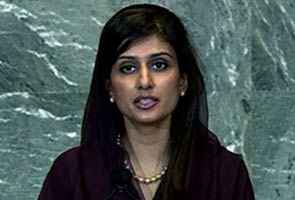
Pak for resolving all issues with India: Foreign Minister Khar said

Pakistan is willing to resolve all outstanding issues, including Kashmir with India, with which it is engaged in a "substantive dialouge" process that it hopes should be "uninterrupted", Foreign Minister Hina Rabbani Khar has said.

Khar was addressing the 193-member UN body on behalf of Prime Minister Yousuf Raza Gilani who could not attend the 66th session due to floods in Pakistan.

The 34-year old Foreign Minister said Pakistan is reaching out to its "immediate neighbours" with a "sincere "desire to join hands and bring about "durable peace and development, by a win-win approach.

"I am happy to note that both Pakistan and India aren ow engaged in a substantive dialogue process. A dialogue process that we in Pakistan hope will be uninterrupted and uninterruptable.

We certainly intend to make this engagement fruitful and premise it on the promise of a mutually rewarding enterprise that would enable us to optimally avail the complementarities that exist," she said in her maiden speech.

Khar said Pakistan looks forward to "resolving all outstanding issues including Kashmir," which is among the oldest on the United Nations agenda and has been the subject of several Security Council resolutions.

"A peaceful resolution that accords fully with the aspirations of the Kashmiris is in dispensable for durable stability as is the need for safe guarding of their fundamental human rights," she said, adding that Pakistan will "support" the human rights of Kashmir is.

Khar further said the reality of a "nuclearised" South Asia imposes on Pakistan and India the "onerous" responsibility to work together for creating mutual confidence, avoiding an arms race and enhancing strategic stability.

"We look forward to moving in this direction in the dialogue process."

She told the international audience that Pakistan attaches "highest importance" to promoting the goals of peace,security and stability in the world.

"In our own region we have relent lessly endeavoured towards creating an environment of shared prosperity and shared peace.

"A democratic, progressive and prosperous Pakistan embedded in a stable, secure and prosperous region guides the framework of our foreign policy."

"As a democratic country, Pakistan will continue to do its best for the cause of global peace and prosperity," she said.

"We will remain unflinchingly democratic. We will defeat those that seek to terrorise us," the Foreign Minister added.

Pakistan will not only work to empower women, it will also protect the weak and the vulnerable in its midst, especially minorities as well as those abroad.

She said Pakistan will overcome challenges and will be a "peaceful and prosperous society".

Monday, September 26, 2011

Test fired developed nuclear capable missile Prithvi-II

India, Monday, test fired its indigenously developed nuclear capable ballistic missile Prithvi-II off the Orissa coast, defence sources said.

The missile was blasted off from the Integrated Test Range at Chandipur, about 230 km from here. The medium-range missile, which can carry a pay-load of 500 kg, has a maximum range of 350 km.

India had successfully test fired its surface-to-surface ballistic missile Shourya from the same test base Saturday.

Thursday, September 15, 2011

US to build ties with India in EA Summit

Aiming to build ties with emerging countries like India and Indonesia, President Barack Obama will attend the East Asia Summit in November, an Obama administration official said. "There are many aspects of our strategy of greater commitment to institutions like the East Asia Summit, President Obama will make his first appearance as US President in November, building ties with emerging states like India and Indonesia, obviously dealing with the extraordinarily complex set of relationships with a country like China," a senior State Department official said. "But at the top of the list is our relationship with our partners and our allies.

We have five treaty allies in Asia – Japan, South Korea, Australia, the Philippines, and Thailand," the official told reporters travelling with the Secretary of State Hillary Clinton enroute to San Francisco to attend the US-Australian Ministerial, better known as the AUSMIN followed by the APEC Women And The Economy summit. He said, over the last seven years, there was already a very strong relationship between Australia and the US, it has become even stronger. "We are working on a variety of things that we'll be discussing over the next couple of days.

We are going to talk directly about how US and Australian forces can operate closely together, can work together in a variety of ways, and to see how Australia can play a role in what is termed the Global Posture Review," the official said. Referring to the relationship between the US and Australia, the official said more recently, their discussions and focus of cooperation has got much further afield.


"We worked very closely on China with Prime Minister Rudd and, who now is Foreign Minister, is probably more than any other leader has just a remarkable command of China, has lectured in Chinese universities in Chinese, and has provided us his expert advice and commentary about how to proceed," he said. "We have worked with Australia on architecture and on trade. Architects in Australia have given us enormously good advice about how to position ourselves in this critical period on Asia. And as importantly, we have worked in what we might call out-of-area pursuits," he said.

"Australia's been enormously helpful in Afghanistan and in efforts on Pakistan. And more recently, Foreign Minister Rudd has been deeply engaged in a variety of efforts associated with supporting the Arab Spring both through bringing together other likeminded nations and also coordinating closely with the US," the official said.

Saturday, September 10, 2011

Obama: Indo-US ties can advance peace in world

Describing the Indo-US strategic partnership as a defining and indispensable collaboration for the 21st century, President Barack Obama has said the two countries share a dynamic and broad relationship that serves to advance peace and prosperity in Asia and the world.

Obama conveyed this to new Indian Ambassador to the US, Nirupama Rao, at a ceremony at the White House last evening during which she presented her credentials.

"President Obama described the India-US global strategic partnership as a defining and indispensable collaboration for the 21st Century," the Indian embassy said in a statement after the ceremony that took place at the Oval Office of the White House.

"He said the two countries enjoy a natural friendship and that the India-US partnership has proven to be dynamic and broad and serves to advance peace and prosperity in Asia and the world," according to the statement.

During the ceremony, Obama warmly welcomed Rao to Washington and wished her every success in her high responsibilities as India's new ambassador to the US.

Rao, in her remarks to Obama, conveyed warm greetings from the President and Prime Minister of India to him and First Lady Michelle Obama, adding that India was greatly encouraged by his strong personal commitment to take the bilateral strategic partnership forward.

Thursday, September 1, 2011

'UK sees India as a leader'

Britain’s minister of state for Commonwealth, Lord David Howell, on Wednesday sought a leadership role for India in reviving the 54-nation Commonwealth.

Speaking at the Indian Council of World Affairs here, Lord Howell said: “The UK sees India, as do other members of the Commonwealth, as a leader, exemplifying the principles that bring the commonwealth together – freedom, democracy, good governance and the rule of law, free trade and human rights.”

He added, “India matters to the Commonwealth, and it is evident that the Commonwealth matters to India."

Hailing the world’s largest democracy, Lord Howell said, “Perhaps India has more than most to gain from the Commonwealth. Not only is India the largest country in the organisation, it is the fourth largest contributor to programmes.”

He further underlined the change in the world order, saying “Economic power and influence is moving east and south, with the rise of the emerging economies in Asia, Africa and Latin America.”

The British Foreign Office minister also insisted on working together on the important global issues.

The Commonwealth is scheduled to hold the summit of its leaders at Perth in Australia in October.

Tuesday, August 30, 2011

Bresnan looking to pile on the pain for Indians in one-day series

England all-rounder Tim Bresnan believes the Indians could be ripe for the picking during next month's one-day series, especially in conditions far removed from their World Cup win back at home.

India will be without five of their World Cup heroes, and Bresnan believes England will be a handful for the relatively new visitors squad.

"India might be favourites because they won the World Cup only a few months ago. But we're quite difficult to beat at home in one-day cricket as we showed against Sri Lanka," the Daily Mail quoted Bresnan, a saying.

"I wouldn't say any team can feel too confident against us in one-day cricket. We're improving all the time and each series is a chance for us to keep doing so," he added.

"If we hit our straps against India we should get the result we're after. We hit them hard in the Test matches and we'll be looking to do the same in the one-dayers," Bresnan said.

"India are a top side and we have to respect them in all forms, especially the shorter ones. But we're out to win every game, that's our mentality," he added.

Thursday, August 18, 2011

Employment onus on India

India will need to generate at least 5.5 crore additional jobs by 2015 if it wants to maintain the current ratio of employed people to total population, a study done by Crisil Research said today.

The study, Employment in India ' Uneven and Weak, said this number of 5.5 crore would be twice the number of jobs created during 2005-10 and that creating these jobs would pose a challenge without adequate policy support. While the current ratio of employed people to the total population stands at 39 per cent, the number of 5.5 crore also comes after accounting for many people employed today either retiring or losing their jobs.

According to the study, despite higher economic growth in the second half of 2000s, the country has been unable to generate sufficient number of jobs in manufacturing and services. For instance, the GDP growth increased to 8.6 per cent during 2005-10 from 6 per cent during 2000-05, but the net addition to jobs remained almost flat at around 2.7 crore during these two periods.

"While net additions to jobs during the second half of the 2000 decade have been higher than the much-discussed two million number, this is clearly not enough to ensure inclusive growth," it said.

Crisil said if the country wanted a solution in this regard, it should look at other countries, including China. The study noted large scale labour-intensive manufacturing units are a rarity in India, since the real cost of employing labour is high.

Moreover, it is also virtually impossible for a manufacturing company with more than 100 employees to fire any employee even if it is facing bankruptcy. Therefore, demand for labour has not increased fast enough in manufacturing.

However, in the service sector, particularly in high-skilled services such as financial intermediation and business services, there is a shortage of skilled labour that is constraining job creation.

Tuesday, August 16, 2011

US:Time for India, China to revisit their position on Syria

The Obama Administration has urged both India and China to "revisit their position" on Syria even as US intensified its international campaign against the authoritarian regime. "We are certainly speaking to them (India and China) in New York," State Department spokesperson Victoria Nulandtold, referring to the talks being held in this regard at the UN headquarters in New York.

"We are speaking to them in Capitals. I think our message publicly has been clear. The Secretary of State, Hillary Clinton said in her interview that she thought it was time for India and China to revisit their position. So those conversations continue," Nuland said, but did not elaborate what kind of conversations the US was holding with these two countries.

She said there were countries that were still trading oil and gas with Syria and countries that have not renounced their willingness to send arms to Syria.

"So we are working to strengthen that coalition and continue to ensure that the message from the international community has teeth. Nobody is satisfied with the situation in Syria. It's abhorrent and repulsive, and our efforts will continue," Nuland said.

she added, and frankly, we continue to believe that the UN Security Council ought to more strongly condemn the violence than it has. We are working on more sanction measures, and we will continue to do so."

Thursday, August 11, 2011

Study :India, China face highest risk from natural disasters

A mapping firm Maplecroft says,Emerging economies like India, China, Philippines and Indonesia face the highest economic risk from natural disasters.

Despite the US and Japan having the highest economic exposure to natural hazards, the aforementioned emerging economies are proportionately at greater risk from them as they lack the capacity to combat the impact of a major disaster.

Natural hazards have been more costly to the world economy in 2011 than any other year on record. The report said. "The tsunami in Japan, tornadoes in the US, the earthquake and flooding in Australia have all contributed to $265 billion for the first six months of the year,"

According to the Natural Hazards Risk Atlas 2011 released by Maplecroft, 196 countries were ranked with respect to their economic exposure to natural hazards like earthquakes, tsunamis, tropical cyclones, floods and drought.

However, a different perspective emerges when countries are ranked in terms of socio-economic resilience, as per which China,

India, the Philippines and Indonesia feature in the 'high risk' category, while countries like the US and Japan were rated as 'low risk'.

Maplecroft's analysis states that large developed economies like the US and Japan have the highest economic exposure to natural hazards, but they also have measures in place to withstand the impact, such as their economic strength, strong governance, well-established infrastructure, disaster preparedness and tight building regulations.
Citing the example of Japan, the report said nearly 40 per cent more people were exposed to tropical cyclones in thatcountry than the Philippines. Yet if both countries experienced similar sized cyclones, fatalities in the Philippines would be 17 times higher than in Japan.

"The emerging economies, although buoyant with growth, lack the socio-economic conditions to limit their disaster risk. This lack of resilience could threaten their economic growth and the extent to which businesses with operations there hope to flourish," Maplecroft CEO Alyson Warhurst said.

"Much of the growth of emerging economies is now based on increasing domestic consumption. As their relative purchasing power grows, so too will the absolute economic value exposed to natural hazards," Warhurst added."Investors, who are currently diversifying portfolios into Asian countries, also need to factor natural hazard risks into their investment strategies".

Tuesday, August 9, 2011

Gold price: Yellow metal on all time high

he October contract on the Multi Commodity Exchange of India was at Rs 25,540, up Rs 298 from its previous close.

In morning benchmark gold futures extended gains by more than 3 per cent and hit a new peak of Rs 26,198 per 10 grams, tailing a rally in the world market and on a weak rupee. It has risen over 11 percent in August.

Rupee fell sharply to its lowest in 10 weeks as a selloff in global equities ignited fears of foreign fund outflows.

International spot gold gained more than 2 percent on Tuesday, roaring to all-time highs for a second consecutive session to stand above $1,750 as equity markets dived on growing fears of a global recession following last week's US credit downgrade.

Asian shares tumbled on Tuesday as investors scrambled to adjust to a rapid downgrade in the outlook for US and global economic growth, but later staged a sharp rebound from early lows, helping cushion expected losses in Europe.

US S&P 500 index futures pulled back sharply from earlier lows and crept into positive territory, while European index futures also pared early losses and were trading down around 0.5 percent.

Thursday, August 4, 2011

HSBC rules out job cuts in India

The country's oldest foreign bank HSBC ruled out job cuts in the country as part of its global recast, saying India is a strategic market and one of the key profit centres and that it is in fact finding it difficult to offset the high attrition rates.

As part of the 30,000 job cuts announced globally yesterday.HSBC, which is the largest bank in Europe, had said it would shed 30,000 jobs as it retreats from countries where it is struggling to compete.

HSBC India Chief Executive Stuart A Davis told today,"There will be a re-allocation of resources  but it's not going to be a cut heads.We are trying to do is to eliminate bureaucracies at the back-end."

HSBC India, the fully-owned subsidiary of the largest European bank, reported a 33% rise in pre-tax profit to USD 451 million from the country, making this unit the sixth most profitable regional for the British lender.

The bank had also said it had already cut 5,000 jobs following restructuring of operations in Latin America, the US, Britain, France and the Middle East and that it would cut another 25,000 between now and 2013.HSBC had said on Sunday it would sell 195 US branches to First Niagara Financial for about USD 1 billion in cash, and close another 13 of the 470 sites it had. HSBC also intends to sell its US credit card portfolio, which has over USD 30 billion in assets to free up capital. The bank now aims to shut or sell retail operations in a further 20 countries.

"I think India already has a very high attrition rate. We are hard-pressed to even catch up on the replacements. There is a war for talent out there, but as I said, there will be reallocation of resources," Davis said.

While HSBC gives some the chop, it’s also giving jobs to others. Apart from the 15,000 people the bank wants to hire in emerging markets, hiring in Hong Kong is ongoing as well. An anonymous source told us that HSBC is on the hunt for mid to senior candidates in risk, finance, operations and prime services.