Showing posts with label Hamid Karzai. Show all posts

Wednesday, November 2, 2011

Istanbul: World to chart Afghan roadmap today

Diplomats are campaigning this week for a stable Afghanistan after the planned withdrawal of international combat forces by the end of 2014, a goal imperilled by militant attacks, a weak Afghan government and the conflicting interests of regional players.

International delegates were converging on Istanbul on Tuesday before the conference on security and economic development in Afghanistan against a backdrop of high-profile assaults in Kabul in the last few months.

Afghan President Hamid Karzai and Pakistan President Asif Ali Zardari met ahead of the regional conference on today amid tension over Afghan and US demands that Pakistan do more to curb militant activity and sanctuaries on its territory.

Karzai urged Pakistan to "move beyond words" and take concrete steps to curb militants which it said were a threat to both countries. They held their first talks since the assassination in September of Afghan peace negotiator Burhanuddin Rabbani.

Karzai urged "all countries in the region (to) cooperate with each other with honesty", in the face of threats, a statement from Karzai's office said. "If that happens, all countries in the region can overcome their problems."

Today's meeting on "Security and Cooperation in the Heart of Asia" will be attended by 14 regional countries: Afghanistan, China, India, Iran, Kazakhstan, Kyrgyzstan, Pakistan, Russia, Saudi Arabia, Tajikistan, Turkey, Turkmenisan, Uzbekistan and UAE. Germany, France and other Western countries with troops deployed in Afghanistan were sending envoys to show support.

Thursday, October 20, 2011

Secretary of State Hillary in Afghanistan to discuss peace moves

Secretary of State Hillary Clinton will discuss possible peace talks and Afghanistan's tricky ties with Pakistan when she meets Afghan President Hamid Karzai and other key leaders in Kabul on Thursday, US officials said.

Hillary’s arrival on Wednesday on an unannounced visit to Afghanistan follows several high profile attacks in the Afghan capital, including an assault on the US embassy in September and days later the assassination of Karzai's top peace envoy, former president Burhanuddin Rabbani.

"She wants to signal US support for a secure and stable Afghanistan," a senior US official told reporters travelling with Hillary.

"She wants to emphasise that the United States remains committed to Afghan reconciliation and will support President Karzai in his efforts, recognising the difficulties that process has undergone since the assassination of Rabbani."

The visit comes as Afghanistan, Pakistan and the United States all see strains in their relations, complicating the outlook as the Obama administration pushes ahead with plans to draw down troops and turn over security responsibility to Afghan forces by the end of 2014.

Efforts to reach a political solution to a conflict now over a decade old will be on Hillary's agenda, along with support for Afghans as they step up their own security work, the official said.

Hillary will meet Karzai and other Afghan officials, US officials said, and hold a round-table meeting with non-government leaders and civil society activists. She will also hold a joint news conference with the Afghan President.

US officials said Hillary would also discuss the future "strategic partnership" between Afghanistan and the United States after 2014, with an eye to eventually formalising the alliance.

"She'll want to point to that as a signal to Afghans, to the region, that the United States will remain committed to Afghanistan beyond 2014."

Hillary is expected to preview plans for conferences on the future of Afghanistan due to be held in Istanbul in November and Bonn in December which US officials hope will tighten international cooperation on political and economic strategies to stabilise the country.

She is also expected to discuss ties between Afghanistan and neighbouring Pakistan, accused by officials in both Afghanistan and the United States with working to undercut the US-led military campaign in order to protect its influence in the region.

Ties between Kabul and Islamabad have been particularly strained since the assassination of Rabbani, who was killed by a suicide bomber posing as a Taliban reconciliation envoy.

Many Afghans, including senior officials, have accused the Pakistan government of having links to the killing, and accused their neighbour of fomenting instability to further its own political interests. Pakistan denies this.

Karzai has been more circumspect, but hinted after the killing that he had lost hope in pursuing peace talks with the Taliban and suggested negotiations with Pakistan instead.

Top US officials have also accused Pakistan of supporting insurgent groups in Afghanistan after September's 20-hour attack on diplomatic targets in Kabul, including the US embassy.

But President Barack Obama and Hillary have both stressed that the US relationship with Pakistan is too important to abandon, although Hillary said last week if Islamabad did not help solve Afghanistan's difficulties it would "continue to be part of the problem”.

Tuesday, October 4, 2011

Afghan President Karzai to seal a new strategic deal with India

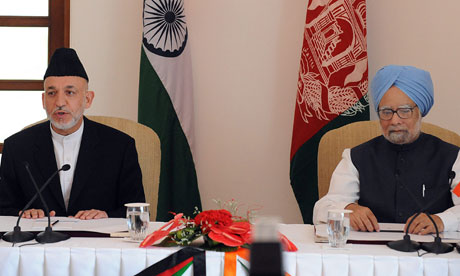
Afghan President Hamid Karzai Tuesday arrived in India on a two-day visit during which the two sides are expected to ink a strategic partnership accord and discuss Pakistani spy agency ISI's alleged complicity in supporting Taliban.

Karzai is expected to brief Prime Minister Manmohan Singh on his revised strategy for reconciliation with the Taliban in the aftermath of the assassination of former president Burhanuddin Rabbani, his chief interlocutor with the Taliban.

The discussions will continue at the dinner the prime minister will host for Karzai, who has been educated in India.

Karzai, who comes here against the backdrop of Afghanistan's souring relations with Pakistan, has indicated he is reviewing his strategy for making peace with the Taliban.

He has also voiced frustration with the failure to establish contact with senior Afghan Taliban leaders like supreme leader Mullah Mohammad Omar, and stressed the need for talks with Pakistan.

Against this background, Karzai is expected to consult Manmohan Singh over ways to bring peace and stability to his violence-torn country, reliable sources said.

In an important step, India and Afghanistan are expected to ink a strategic partnership agreement that was envisaged in the May 12 joint declaration during Manmohan Singh's visit to Kabul.

The strategic accord is aimed at bolstering cooperation against international terror and could include India training Afghan security forces for counter-terror operations.

The agreement could lead to institutionalising dialogue at the level of the National Security Adviser to discuss the security issues.

The two sides may also sign agreements related to mineral exploration.

"The visit provides an opportunity for both countries to consolidate their strategic partnership and discuss bilateral, regional and global issues of mutual interest," the external affairs ministry said here Monday while announcing Karzai's visit.

Karzai will deliver the Third R.K. Mishra Memorial Lecture on India-Afghanistan relations at the Observer Research Foundation, a think tank, Wednesday. The lecture will be chaired by External Affairs Minister S.M. Krishna.

Issues relating to expanding trade, commerce and connectivity with a view to making Afghanistan a hub for regional trade will figure in the discussions, said a reliable source.

India has pledged $2 billion for a slew of development projects in Afghanistan, making it one of the largest regional donors to the violence-hit country.

Rabbani, a former Afghan president, was heading the Afghan High Council which was entrusted with the task of reconciliation with the Taliban. He was assassinated by a suicide bomber outside his home in Kabul Sep 20.

A statement released by Karzai's presidential palace in Kabul Sunday said new evidence showed that Rabbani's killer was "a citizen of Pakistan".

The statement also asked Pakistan to extradite people involved in the assassination of Rabbani, marking a further downturn in Afghan-Pakistan relations which have been strained by Pakistan's suspected continuing support to the Taliban militants.

Pakistan's Foreign Office has strongly rejected the allegations of the ISI's involvement in Rabbani's killing and asked Kabul to desist from "making such irresponsible statements".