Showing posts with label Afghanistan. Show all posts

Wednesday, November 2, 2011

Istanbul: World to chart Afghan roadmap today

Diplomats are campaigning this week for a stable Afghanistan after the planned withdrawal of international combat forces by the end of 2014, a goal imperilled by militant attacks, a weak Afghan government and the conflicting interests of regional players.

International delegates were converging on Istanbul on Tuesday before the conference on security and economic development in Afghanistan against a backdrop of high-profile assaults in Kabul in the last few months.

Afghan President Hamid Karzai and Pakistan President Asif Ali Zardari met ahead of the regional conference on today amid tension over Afghan and US demands that Pakistan do more to curb militant activity and sanctuaries on its territory.

Karzai urged Pakistan to "move beyond words" and take concrete steps to curb militants which it said were a threat to both countries. They held their first talks since the assassination in September of Afghan peace negotiator Burhanuddin Rabbani.

Karzai urged "all countries in the region (to) cooperate with each other with honesty", in the face of threats, a statement from Karzai's office said. "If that happens, all countries in the region can overcome their problems."

Today's meeting on "Security and Cooperation in the Heart of Asia" will be attended by 14 regional countries: Afghanistan, China, India, Iran, Kazakhstan, Kyrgyzstan, Pakistan, Russia, Saudi Arabia, Tajikistan, Turkey, Turkmenisan, Uzbekistan and UAE. Germany, France and other Western countries with troops deployed in Afghanistan were sending envoys to show support.

Monday, October 31, 2011

A Suicide car blast near UNHCR building in Kandahar

Three Afghan civilians were killed in a suicide attack in the southern Afghan city of Kandahar early on today, authorities in Kandahar said.

The blast was close to the Office of the United Nations High Commissioner for Refugees (UNHCR) building in Kandahar, the UN said.

"We are aware of an explosion which took place earlier this morning in the vicinity of the UNHCR guest house," United Nations spokesman Dan McNorton said. "All our international staff are accounted for ... the incident is still ongoing. We are working through our processes to make sure all our Afghan staff are safe."

Authorities in Kandahar said three civilians had been killed, describing the incident as a suicide attack.

"(There have been) three local civilians killed and another one wounded. A Nepali is wounded too," the provincial governor's media office said on its Twitter feed, adding that two armed attackers were still shooting at security forces.

The attack is the latest in a string of lethal assaults on foreigners in Afghanistan.

On Saturday, a suicide car bomber killed 13 troops and civilian employees of the NATO-led International Security Assistance Force (ISAF) in Kabul, including Americans, Britons and a Canadian, in the deadliest single ground attack against the coalition in 10 years of war in Afghanistan.

US ready to talk to Taliban chief Mullah Omar

US Secretary of State Hillary Clinton has said that Washington is ready to negotiate with Taliban leader Mullah Omar, as his involvement is crucial for the prospects of peace in Afghanistan.

According to the Age, Clinton’s comments are seen as a significant shift in US policy, from moves to divide the Taliban-led insurgency and isolate Omar, to an acknowledgement of his leadership.

Earlier, the Haqqani network’s commander, Sirajuddin Haqqani, warned Washington that only the Quetta Shura, the Taliban-led militant organisation, could negotiate a peace deal and that his fighters would not be divided.

In an appearance before the House foreign affairs committee, Clinton said the US would continue to “fight, talk and build” in Afghanistan and Pakistan to test any willingness to negotiate.

Clinton said there was “evidence going both ways” on its intentions.

She said last month's Haqqani meeting was not a “negotiation” and that no meetings had followed it, but she stressed that any negotiations with the Taliban in the future would require the Quetta Shura’s blessing.

Thursday, October 20, 2011

Secretary of State Hillary in Afghanistan to discuss peace moves

Secretary of State Hillary Clinton will discuss possible peace talks and Afghanistan's tricky ties with Pakistan when she meets Afghan President Hamid Karzai and other key leaders in Kabul on Thursday, US officials said.

Hillary’s arrival on Wednesday on an unannounced visit to Afghanistan follows several high profile attacks in the Afghan capital, including an assault on the US embassy in September and days later the assassination of Karzai's top peace envoy, former president Burhanuddin Rabbani.

"She wants to signal US support for a secure and stable Afghanistan," a senior US official told reporters travelling with Hillary.

"She wants to emphasise that the United States remains committed to Afghan reconciliation and will support President Karzai in his efforts, recognising the difficulties that process has undergone since the assassination of Rabbani."

The visit comes as Afghanistan, Pakistan and the United States all see strains in their relations, complicating the outlook as the Obama administration pushes ahead with plans to draw down troops and turn over security responsibility to Afghan forces by the end of 2014.

Efforts to reach a political solution to a conflict now over a decade old will be on Hillary's agenda, along with support for Afghans as they step up their own security work, the official said.

Hillary will meet Karzai and other Afghan officials, US officials said, and hold a round-table meeting with non-government leaders and civil society activists. She will also hold a joint news conference with the Afghan President.

US officials said Hillary would also discuss the future "strategic partnership" between Afghanistan and the United States after 2014, with an eye to eventually formalising the alliance.

"She'll want to point to that as a signal to Afghans, to the region, that the United States will remain committed to Afghanistan beyond 2014."

Hillary is expected to preview plans for conferences on the future of Afghanistan due to be held in Istanbul in November and Bonn in December which US officials hope will tighten international cooperation on political and economic strategies to stabilise the country.

She is also expected to discuss ties between Afghanistan and neighbouring Pakistan, accused by officials in both Afghanistan and the United States with working to undercut the US-led military campaign in order to protect its influence in the region.

Ties between Kabul and Islamabad have been particularly strained since the assassination of Rabbani, who was killed by a suicide bomber posing as a Taliban reconciliation envoy.

Many Afghans, including senior officials, have accused the Pakistan government of having links to the killing, and accused their neighbour of fomenting instability to further its own political interests. Pakistan denies this.

Karzai has been more circumspect, but hinted after the killing that he had lost hope in pursuing peace talks with the Taliban and suggested negotiations with Pakistan instead.

Top US officials have also accused Pakistan of supporting insurgent groups in Afghanistan after September's 20-hour attack on diplomatic targets in Kabul, including the US embassy.

But President Barack Obama and Hillary have both stressed that the US relationship with Pakistan is too important to abandon, although Hillary said last week if Islamabad did not help solve Afghanistan's difficulties it would "continue to be part of the problem”.

Tuesday, October 4, 2011

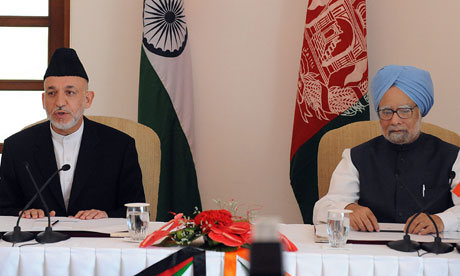
Afghan President Karzai to seal a new strategic deal with India

Afghan President Hamid Karzai Tuesday arrived in India on a two-day visit during which the two sides are expected to ink a strategic partnership accord and discuss Pakistani spy agency ISI's alleged complicity in supporting Taliban.

Karzai is expected to brief Prime Minister Manmohan Singh on his revised strategy for reconciliation with the Taliban in the aftermath of the assassination of former president Burhanuddin Rabbani, his chief interlocutor with the Taliban.

The discussions will continue at the dinner the prime minister will host for Karzai, who has been educated in India.

Karzai, who comes here against the backdrop of Afghanistan's souring relations with Pakistan, has indicated he is reviewing his strategy for making peace with the Taliban.

He has also voiced frustration with the failure to establish contact with senior Afghan Taliban leaders like supreme leader Mullah Mohammad Omar, and stressed the need for talks with Pakistan.

Against this background, Karzai is expected to consult Manmohan Singh over ways to bring peace and stability to his violence-torn country, reliable sources said.

In an important step, India and Afghanistan are expected to ink a strategic partnership agreement that was envisaged in the May 12 joint declaration during Manmohan Singh's visit to Kabul.

The strategic accord is aimed at bolstering cooperation against international terror and could include India training Afghan security forces for counter-terror operations.

The agreement could lead to institutionalising dialogue at the level of the National Security Adviser to discuss the security issues.

The two sides may also sign agreements related to mineral exploration.

"The visit provides an opportunity for both countries to consolidate their strategic partnership and discuss bilateral, regional and global issues of mutual interest," the external affairs ministry said here Monday while announcing Karzai's visit.

Karzai will deliver the Third R.K. Mishra Memorial Lecture on India-Afghanistan relations at the Observer Research Foundation, a think tank, Wednesday. The lecture will be chaired by External Affairs Minister S.M. Krishna.

Issues relating to expanding trade, commerce and connectivity with a view to making Afghanistan a hub for regional trade will figure in the discussions, said a reliable source.

India has pledged $2 billion for a slew of development projects in Afghanistan, making it one of the largest regional donors to the violence-hit country.

Rabbani, a former Afghan president, was heading the Afghan High Council which was entrusted with the task of reconciliation with the Taliban. He was assassinated by a suicide bomber outside his home in Kabul Sep 20.

A statement released by Karzai's presidential palace in Kabul Sunday said new evidence showed that Rabbani's killer was "a citizen of Pakistan".

The statement also asked Pakistan to extradite people involved in the assassination of Rabbani, marking a further downturn in Afghan-Pakistan relations which have been strained by Pakistan's suspected continuing support to the Taliban militants.

Pakistan's Foreign Office has strongly rejected the allegations of the ISI's involvement in Rabbani's killing and asked Kabul to desist from "making such irresponsible statements".

Wednesday, September 28, 2011

Haqqani was once a White House guest!

Even as the administration of President Barack Obama is engaged in a war of words with Pakistan over acting against the deadly Haqqani network, reports, today, claimed that its founder Jalaluddin Haqqani was once a key ally of the US government.

Reports quoted Pakistan’s Interior Minister Rehman Mallik saying, “The network’s aging leader, Jalaluddin Haqqani, was a respected commander and key US and Pakistani ally in resisting the Soviet Union after its 1979 invasion of Afghanistan. Haqqani even visited President Ronal Reagan at the White House.”

Mallik even claimed that in 1992, three years after the Soviet withdrawal, Haqqani and others seized power in Afghanistan with US approval. In the 1980s and 1990s, Haqqani also hosted Saudi fighters including Osama bin Laden. That hospitality is believed to have been extended to al Qaida and other foreign fighters on both sides of the border today.

After the Taliban seized power in the mid-1990s, it made Haqqani a government minister. Following the Islamist regime’s ouster he was again offered Cabinet posts – this time by Afghan President Hamid Karzai. But he decided to focus on ridding Afghanistan of Western troops.

Malik also refuted claims that Pakistan’s spy agency ISI was backing the Haqqani network and training its members. Talking to media-persons at a ceremony held to laud the Islamabad police over the recovery of a huge cache of weapons, Mallik said, “CIA (Central Intelligence Agency) of the United States actually created the Haqqani network and those claiming otherwise should give the evidence of its presence in Pakistan.”

“We will fight the terrorists as our forces are capable of handling them and countering any challenge,” the minister was quoted as saying.

Mallik also stated Pakistan’s seriousness in combating terrorism is evident from its action against militants in SWAT and other troubled areas, which shows that the law enforcement agencies were making sincere efforts to root out the menace of terrorism.

He said that the nation was confident of the capabilities of Pakistan Army, government leadership and its strength as Pakistanis.

The alliance between Pakistan and the United States in the 10-year war in Afghanistan and against al Qaeda hit rock bottom this year in the wake of the unilateral American raid that killed Osama bin Laden near Islamabad on May 2.

The US administration then asked the Pakistani government to clamp down on the Haqqani network, which is responsible for attacks on the US embassy in Kabul and on ISAF as well as some others.

Wednesday, September 21, 2011

Former Afghan President Rabbani killed by suicide bomber

Former Afghan President Burhanuddin Rabbani, who headed a government peace council set up to facilitate contacts with Taliban insurgents, was assassinated Tuesday by a suicide bomber concealing explosives in his turban, officials said. Four of Rabbani's bodyguards also died and a key presidential adviser was wounded.

President Hamid Karzai cut short a visit to the US over the attack, which dealt a harsh blow to peace efforts after a decade of war.

The turban bomber entered Rabbani's house in the capital Kabul on Tuesday evening and blew himself up inside, said Mohammad Zahir, the chief of criminal investigation for the Kabul police.

Rabbani headed the country's High Peace Council, which was set up by the Afghan government to work toward a political solution to the decade-long war. However, it had made little headway since it was formed a year ago.

Rabbani was president of the Afghan government that preceded the Taliban rule. After he was driven from Kabul in 1996, he became the nominal head of the Northern Alliance, mostly minority Tajiks and Uzbeks, who swept to power in Kabul after the Taliban's fall. Rabbani is an ethnic Tajik.

His killing dampens hopes of starting peace negotiations with Taliban insurgents and also will hamper efforts to keep regional and ethnic rivalries, which feed the insurgency, in check.

As one of the wise old man of Afghan politics and the leader of the anti-Taliban Northern Alliance, Rabanni's role in the attempts to reach out to the Taliban and seeking a political deal with them — with the US blessing — will be hard to replicate in the near future.

His death could unleash a well of resentment building up among some senior Northern Alliance members, who accuse President Hamid Karzai of colluding with the Taliban.

Already Afghanistan's ethnic minorities have begun to re-arm in the face of negotiations with the Taliban. Rabbani's death is likely to accelerate the re-arming and lay the foundation for a bitter civil war once US troops leave the country in 2014.

Karzai's adviser Mohammad Masoom Stanekzai was wounded in the attack. A relative who answered Stanekzai's phone said that the wounds did not appear to be life-threatening, but Stanekzai was in the hospital. The relative declined to give his name because of the sensitivity of the situation.

Stanekzai is chief executive of the Afghanistan Peace and Reintegration Program, a highly touted program funded by the US and its coalition allies to bring mid- and lower-level Taliban back into Afghan society. The program has so far only managed to reintegrated about 2,000 of the estimated 25,000-40,000 insurgents in Afghanistan.

Reintegration was the other half of reconciliation, which is aims to try and broker a peace deal with the senior Taliban leadership.