Showing posts with label US stocks. Show all posts

Thursday, October 20, 2011

Asian shares lower, euro capped ahead of Europe

Asian stocks fell on Thursday, as growing investor caution about taking risks ahead of a key European leaders' summit at the weekend weighed on riskier assets across the board and supported safe-haven government bonds.

The euro struggled to make much headway, having pared gains on Thursday on fresh reports suggesting Europe remains a long way from resolving its debt woes. The single currency was up 0.1 percent against the dollar at USD 1.3770.

Plans to tackle the euro zone debt crisis have stalled, with Paris and Berlin at odds over how to increase the firepower of the region's bailout fund, French President Nicolas Sarkozy said on Wednesday, heightening concerns about how much progress could be made at a summit of European leaders on Sunday.

Investors are looking for more details from the meeting of plans to contain the euro zone sovereign debt crisis, particularly beefing up the rescue fund, a vehicle to guarantee national governments' sovereign debt issuance, although many believe a rapid solution is unlikely.

The meeting is also expected to agree on a plan to recapitalize European banks, but a report in the Financial Times said on Thursday that the plan to strengthen Europe's banking system is set to fall short of market expectations.

MSCI's broadest index of Asia Pacific shares outside Japan fell 0.6 percent, with the materials sector leading the decline, falling 1.5 percent.

Australian shares fell 1.2 percent on Thursday as miners sank after copper and gold prices fell, while Japan's Nikkei stock average opened down 0.4 percent.

The MSCI world stocks index was down 0.3 percent at 297.88, while US stocks ended lower on Wednesday as sentiment was also undermined by the Federal Reserve's Beige Book report, which suggested the outlook for the US economy grew dimmer in September.

Oil edged up in early Asia on Thursday, after falling the day before on concerns about growth. Brent crude futures were up 0.4 percent to USD 108.88 a barrel, while US crude futures edged 0.2 percent higher at USD 86.30 a barrel.

In Asian credit markets, spreads on the iTraxx Asia ex-Japan investment grade index, a gauge for whether investor risk appetite is returning, widened a tad by 1 basis point.

US Treasury prices rose modestly on Wednesday, with benchmark 10-year Treasury notes trading up 4/32 in price to yield 2.16 percent, down from 2.18 percent late Tuesday.

Gold fell for a third consecutive session on Wednesday, moving once again in tandem with riskier assets, as jittery investors sold on a lack of progress over euro zone debt talks and an uncertain US economic outlook. Spot gold was steady at USD 1,641.49 an ounce.

Saturday, September 24, 2011

High-flying gold crashes in record $100 freefall

Gold prices slumped more than USD 100 an ounce on Friday, the biggest fall on record in dollar terms, as traders sold to cover losses, while global stocks edged up on expectations the European Central Bank will take new measures to contain the euro zone debt crisis.

Trading was volatile, capping one of the most tumultuous weeks on record for world markets as fear of a Greek default and a gloomy Federal Reserve prognosis for the US economy sparked a sell-off in stocks and commodities and drove investors to the safe-haven US dollar and Treasuries.

A pledge by G20 policy makers that they will calm the global financial system failed to appease investors, who are concerned that authorities are unable to respond effectively to the mounting euro zone debt crisis and sluggish growth in major world economies.

Gold slumped more than 6 percent at one point -- its biggest drop since the financial crisis in 2008 -- to hit its lowest since early August as a slide turned into a free-fall, with weeks of volatility and talk of hedge fund liquidation wrecking its safe-haven status.

"The bull case for gold is on pause for the near term," said Adam Klopfenstein, senior market strategist for precious metals at MF Global in Chicago.

"In the near-term, the flight-to-quality interest in owning gold is also out of the window as people are not interested in buying it even in the face of fears in the economy. Until it stabilizes, I'm staying out of this market."

Spot gold was last at USD 1,649 an ounce, after falling to a session low under USD 1,628. At USD 127 an ounce, the intraday move was the biggest on record in dollar terms.

US stocks ended higher after seesawing between gains and losses, stopping the bleeding after a disastrous four days of selling marred by severe anxiety.

Comments from European Central Bank Governing Council member Ewald Nowotny, who said it might be advisable for the central bank to add more liquidity to European banks helped lift sentiment.

The Dow Jones industrial average ended up 37.65 points, or 0.35 percent, at 10,771.48. The Standard & Poor's 500 Index was up 6.87 points, or 0.61 percent, at 1,136.43. The Nasdaq Composite Index was up 27.56 points, or 1.12 percent, at 2,483.23.

Global stocks as measured by the MSCI All-Country index were up 0.2 percent, after hitting their lowest level since July 2010 at 274.20.

The index is now in bear market territory -- defined as a fall of 20 percent or more from the peak -- having tumbled more than 22 percent from its 2011 high in May.

"Financial markets are sick and tired of the authorities in Europe and in the US twiddling their thumbs and not doing substantive things to solve this crisis of the global economy," said Barton Biggs, managing partner at New York-based Traxis Partners.

The FTSEurofirst 300 index ended up 0.8 percent. Emerging markets stocks slid 1.6 percent.

Liquidity comments from ECB officials and speculation the central bank may cut rates helped sentiment initially, but uncertainty about Greece remained.

Greece denied reports that one option in its debt crisis would be an orderly default with a 50 percent haircut, while Deutsche Bank warned that European banks' write-downs on Greek bonds could exceed 25 percent.

Metals prices plunged across the board. Silver prices posted their biggest drop since 2006. Spot silver was down 15 percent and trading below USD 35.76 an ounce after hitting a session low of $29.77.

Copper hit USD 7,115.75, its lowest since August 2010. It was its sharpest weekly decline in nearly three years for the economically sensitive red metal.

US crude fell 66 cents to settle at USD 79.85 a barrel. London Brent crude fell USD 1.52 to settle at USD 103.97.

The euro rose 0.4 percent to USD 1.3515, rebounding from an eight-month low. The dollar rose 0.5 percent to 76.66 yen and was on track for its best month since May 2010 against a basket of currencies.

US Treasuries prices slipped after a huge rally this week.

Benchmark US 10-year notes were down 1-2/32 in price, with yields rising to 1.84 percent. Prices of 30-year bonds were down 2-1/32, yielding 2.90 percent.


Wednesday, August 24, 2011

Rupee down by 17 paise at Rs 45.80 per US dollar

The Indian rupee was down by 17 paise at Rs 45.80 per US dollar in early trade today on month-end dollar demand from importers, despite weakness of the greenback in overseas markets.

The rupee resumed lower at Rs 45.70/72 per dollar on the Interbank Foreign Exchange, as against its previous close of Rs 45.63/64 per dollar, and hovered in a range between Rs 45.70 and Rs 45.80 per dollar during morning deals before quoting at Rs 45.75/76 per dollar at 1030 hours.

Month-end dollar from importers, mainly oil refiners, was primarily responsible for the rupee's slide against the dollar, a forex dealer said.

In New York, the dollar slipped against other major currency rivals yesterday as weak data out of the US and better news from Europe supported the euro amid further expectations that the Federal Reserve will take action to try to buoy the US economy.

Currency traders were also keeping close tabs on the solid gains in US stocks yesterday, an indicator that investors are shifting back to riskier assets.

Tuesday, August 2, 2011

Nifty seen Lower, Banks, Tech Down

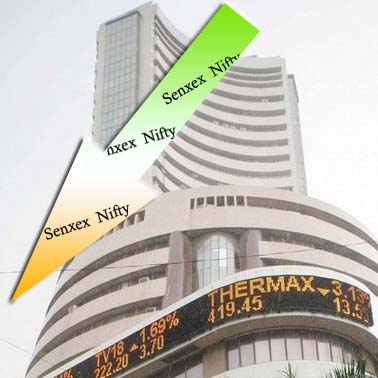
Indian markets were witnessing selling pressure, in line with other peers, as weak manufacturing data from the US spooked sentiments. Realty, banks and technology were the worst hit while pharmaceutical space was marginally higher.

Nikkei 225 was down 1.32 per cent, Hang Seng declined 0.69 per cent and Seoul Composite fell 2.38 per cent.

Well, looks like the euphoria over the US debt deal has given way to concerns about the health of the global economy. Manufacturing PMI reports from Australia to the US have shown continued moderation. Concerns have also surfaced over the adverse implications of the large spending cuts in the US on the world's largest economy. In addition, a possible downgrade of the US debt rating is still lurking.

At 10:15 AM; National Stock Exchange's Nifty was at 5461.85, down 54.95 points or 1 per cent. The broader index touched a high of 5496.30 and low of 5456.40 in trade so far.
US stocks reversed early gains to finish in the red. Across the Atlantic, European stocks suffered nasty cuts. Asian markets this morning are mostly lower. Nifty futures trading in Singapore are pointing to a weak start.

The trading for the rest of the day will hinge partly on global cues and partly on domestic factors. DLF, MMTC, Piramal Healthcare and Power Grid are among the few companies declaring their results today.

Meanwhile, the government is trying its best to convince all that there is no policy drift and that reforms are on track. The monsoon session will be a key test, as spate of crucial bills are slated for presentation.

Bombay Stock Exchange's Sensex was at 18120.06, down 194.27 points or 1.06 per cent. The 30-share index touched intraday low of 18118.30 and high of 18283.55.