Showing posts with label UK. Show all posts

Monday, October 31, 2011

GCHQ chief reports 'disturbing' cyber attacks on UK

The UK has been subject to a "disturbing" number of cyber attacks, the director of communications intelligence agency GCHQ has said.

Sensitive data on government computers has been targeted, along with defence, technology and engineering firms' designs, Iain Lobban said in the Times.

There was a "significant" unsuccessful internet-based attack on Foreign Office computer systems this summer, he added.

On Tuesday, the government hosts a two-day conference over the issue.

Foreign Secretary William Hague convened the London Conference on Cyberspace against a backdrop of the UK treating the threat from cyber warfare as seriously as that from international terrorism.

It aims to bring together political leaders, such as US Secretary of State Hillary Clinton and EU digital supremo Neelie Kroes, with leading cyber security experts and technology entrepreneurs such as Wikipedia founder Jimmy Wales and Cisco vice-president Brad Boston.

Mr Hague believes a "global co-ordinated response" is required to forge policy on cyber development.

Writing in the Times, Mr Lobban said such an inclusive approach was vital.

"The volume of e-crime and attacks on government and industry systems continues to be disturbing," he wrote.

"I can attest to attempts to steal British ideas and designs - in the IT, technology, defence, engineering and energy sectors, as well as other industries - to gain commercial advantage or to profit from secret knowledge of contractual arrangements.

"Such intellectual property theft doesn't just cost the companies concerned; it represents an attack on the UK's continued economic wellbeing."

Mr Lobban added that government online taxation and benefits services could be targeted in future and said a black economy had already developed which saw UK citizens' credit card details offered for sale.

Tuesday, October 4, 2011

UK to change rules to deport foreign criminals?

Faced with the inability to deport foreign criminals on grounds of human rights, Britain is likely to change immigration rules so that such individuals do not take recourse to an individual's "right to family life" under human rights rules to stay in the country.

Home secretary Theresa May, has made known her opposition to Article Eight in the European Convention on Human Rights that enables foreign nationals who commit crime in Britain to avoid deportation on the ground that they have set up a family in the country.

May is reported to be examining how to make clear in the immigration rules that a foreign national can be deported when they have been convicted of a criminal offence, breached immigration rules, set up a family life while in the UK illegally, chosen Britain as their country of residence or are unable to support themselves financially.

Prime Minister David Cameron said in an interview, "The problem here is that there are foreign criminals in Britain, people sometimes actually who still threaten our country or could threaten our country.

We are unable to deport them because they appeal to the courts under Article Eight of this charter, which is the right to a family life".

He added, "You are able to change the immigration rules and ask them to look more carefully about the danger these individuals pose.

The right to a family life is not an inalienable right in the European convention so I believe this change will work.

It is not the whole solution to the problem but it is a good start."

He added, "And you are able to change the immigration rules and ask them to look more carefully about the danger these individual pose. The right to family life is not an inalienable right in the European Convention, so we believe this change can work."

At the Conservative party conference in Manchester today, May is expected to announce her plans to stop foreign criminals from abusing the human rights rules to avoid deportation on the ground of an individual's "right to family life".

Last year there were 102 successful appeals against deportation on human rights grounds which cited Article Eight.

The Article, which ensures the right to a family life, has been cited by some foreign criminals fighting expulsion from Britain.

Many foreign criminals have avoided deportation by claiming that because they have partners or children in the UK, being thrown out of the country would infringe their rights under Article Eight.

Monday, September 5, 2011

‘Bodyguard’ shatters Shah Rukh’s overseas record!

The King of overseas Shah Rukh Khan now has reason to worry for ‘Bodyguard’s stupendous success has rocked his throne real hard.

The craze of SRK’s diehard fans overseas can challenge any of the A-list Hollywood star, but Salman’s ‘Bodyguard’ has come as a big blow to the hero’s monopoly and unconditional adoration that SRK enjoys internationally.

Even as the collection of Salman Khan starrer `Bodyguard` has left mouths wide open, film has surpassed the record of Shah Rukh Khan in the overseas market.

As per box-office reports, Salman has broken his archenemy Shah Rukh’s overseas record by minting 194,000 pounds with his latest outing ‘Bodyguard’, on its opening day in UK, and this is apparently 3000 pounds more than what SRK’s ‘My Name Is Khan’ had grossed on its release day in UK.

Reportedly, SRK’s “my name Is Khan’ collected 191,000 pounds on its first day in UK.

‘Bodyguard’ is also on its way to becoming the highest grosser in the Middle East. It has collected $1.6 million in the first two days, just a little behind the previous highest grosser ‘Dabangg’ which collected $1.7 million.

With the Salman-starrer entertainer fetching such a mind-blowing box-office collections abroad, King Khan, who till date ruled the international market, has apparently descended to the second slot.

Meanwhile, Salman’s much talked nerve surgery was a success in US, but his health continues to be a subject of worry. The star said that while he was being operated, the doctors detected an aneurysm, so he might have to be back for another procedure around January in the States.

Friday, August 26, 2011

Recipe for enjoying a later life

Most of us know that the secret of long life lies in our genes. However not many believe to live a happy old life we require things like chit-chat with friends, healthy diet and regular exercise. But, now experts too support his theory.

According to experts in Britain, our genetic make-up is thought to contribute just 25 percent to how long we live. The real key involves simple measures such as regular exercise, indulging in a natter with friends and eating healthy food.

Age UK, a charity, states it's never too early or too late to adopt a healthy lifestyle to improve later life.

It says its guidelines, which include taking enough good-quality sleep, engaging socially with other people, and staying positive about ageing, can make a big difference to how people age.

It also suggests people to do regular exercise, take a healthy diet, undergo check-ups and not to smoke, besides asking for protecting one's eyes and avoiding sun damage.

The charity also urges people - for both physical and mental well-being - to keep an eye on their pensions and to seek expert financial advice when necessary.

According to Ian Philp, the professor who helped produce the information, said: 'We really can influence how we age and the top tips are a great guide to ageing better. For example, it may seem obvious but regular health check-ups are really important.

'Getting early diagnosis of an illness, taking advantage of screening programmes and being up to date with vaccines are all crucial. Others tips - such as engaging socially with others and staying positive about ageing - are also key.'

The guidelines hold relevance for Britain in particular, as the number of people aged 60 or over in the country, is anticipated to surpass the 20 million mark by 2031.

Friday, August 12, 2011

Are models getting too young?

It’s a fashion shoot that was published several months ago in France, but the provocative shots of 10-year-old French model Thylane Loubry Blondeau in French Vogue are continuing to garner press attention and criticism in the UK and US after they were used in a discussion about pre-teen sexualisation on the Good Morning America show last week.

The shoot, which appears in the Tom Ford edited December 2010 edition of French Vogue, features young children, including 10-year-old Thylane, in slinky heels and low-cut designer dresses, dripping in expensive gold jewellery, reclining on tiger-skins and a chaise lounge. This has left many questioning the tastefulness of the shoot, with some condemning the images as indecent.

Thylane’s mother inititally spoke out to defend the shoot but has since only further highlighted the issue at hand, by stating on Facebook that she wants to protect her daughter from this scandal, as ‘she’s so young’, before closing her Facebook page down earlier this week.

With actresses like 14-year-old Hailee Steinfeld and 13-year-old Elle Fanning being chosen to front major fashion campaigns for Miu Miu and Marc by Marc Jacobs respectively, is the fashion industry developing a worrying obsession with underdeveloped, pre-teen girls? The Elle Fanning advertisements feature her in a Lolita-esque pose, drawing comparisons with Nabokov’s novel about a paedophile. The book may be a literary classic, but surely it’s not something that should be referenced by using a 13-year-old girl to sell perfume?

The use of underage models in photo shoots and advertising campaigns is a worrying, dangerous trend. Sexualising children in this way is a dangerous game - what happens to these child models when they grow up and are no longer desirable for such shoots? Will they develop eating disorders to stay child-like, and thus, wanted? And apart from that, we’re finally starting to break away from the traditional concept that unattainably skinny waifs are the height of beauty. Why would anyone want to go back there again?

Wednesday, August 10, 2011

After three nights Police calm London Riots

On Aug-4 Police investigating gun crime in the black community shoot 29-year-old Mark Duggan after stopping him in a taxi in Tottenham, north London. He dies at the scene after the shooting. Britain's police watchdog opens an inquiry into the fatal shooting.

Rioters have looted shops, set fire to buildings and clashed with police in three nights of disorder in London.

Now London remained largely quiet with a heavy police presence on the streets but unrest spread across central and northern England on a fourth night of violence that has blighted the David Cameron government's image and ability to hold the 2012 London Olympics safely.

With 16,000 police officers deployed in London, the streets remained calm after three previous nights of rioting.

But there was unrest in Manchester, Salford, Liverpool, Wolverhampton, Nottingham, Leicester and Birmingham with shops being looted and set alight.

So far 768 people have been arrested and 105 charged in connection with violence in the capital.

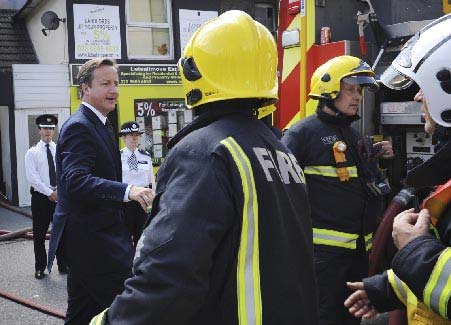
British Prime Minister David Cameron said he would recall parliament from its summer recess for a day on Thursday after rioting swept through London for three consecutive nights.

Talking tough, the Prime Minister, who rushed home after cutting short his vacation in Italy, said the culprits will be brought to bear the consequences of their actions and the government was determined to see that justice is delivered to the law abiding citizens.

Deputy Assistant Commissioner Stephen Kavanagh said, never before fired to deal with riots in England - would be "considered carefully" in the event of further disorder. Sporadic violence has broken out in several cities around England last night.

Monday, August 8, 2011

London burns as youths run riot after shooting

In one of the worst riots in the UK, mob torched several vehicles and buildings and clashed with security forces in an economically poor area of London overnight , injuring 26 officers, after police shot dead a 29-year-old local.

The protest was against the Thursday killing of resident Mark Duggan by police teams dealing with gun crime in Tottenham, dominated by the Afro-Caribbean community . Over 26 police officers were injured as angry groups of people engaged in pitched fights with riot police.

The police said 42 people were taken into custody. Emergency services worked to restore order and the situation was brought under control by Sunday.
About 300 people had gathered outside a police station on the Tottenham High Road last evening demanding justice. The protest was initially peaceful but turned violent overnight as mobs went on a rampage outside the police station.

"The rioting in Tottenham last night was utterly unacceptable ," a Downing Street spokesman said. "There is no justification for the aggression the police and the public faced, or for the damage to property. There is now a police investigation into the rioting and we should let that process happen," the statement said.

The last time similar trouble erupted in the area was in 1985, when a police officer was hacked to death with a machete in Tottenham, after he was set upon by a mob.