Showing posts with label Syria. Show all posts

Friday, November 25, 2011

Syria faces Arab sanctions deadline over monitors

Syria faces a Friday deadline to sign an Arab deal allowing monitors into the country or incur sanctions over its crackdown on protests including halting flights, curbing trade and stopping deals with the central bank.

Arab foreign ministers warned in Cairo that unless Syria agreed to let the monitors in to assess progress of an Arab League plan to end eight months of bloodshed, officials would consider imposing sanctions on Saturday.

Under a November 2 Arab League initiative, Syria agreed to withdraw troops from urban centers, release political prisoners, start a dialogue with the opposition and allow monitors and international media into the country.

Since then hundreds of people, including civilians, security forces and army deserters, have been killed as the unrest which the United Nations says has claimed at least 3,500 lives since March continued unabated.

The Syrian Observatory for Human Rights, a British-based opposition group, said at least 47 people were killed in Syria on Thursday, including 16 soldiers and 17 army deserters, mostly around the rebellious city of Homs and near the town of Rastan to the north.

The violence has prompted former ally Turkey to bluntly tell President Bashar al-Assad to step down and led France to propose "humanitarian corridors" in Syria to help transport medicines or other supplies to civilians in need.

French Foreign Minister Alain Juppe said he would discuss the idea with the Arab League but a source at the 22-member body said the proposal was not brought up at the Cairo meeting.

"In the case that Syria does not sign the protocol ... or that it later violates the commitments that it entails, and does not stop the killing or does not release the detainees ...  will meet on Saturday to consider sanctions on Syria," the Arab ministers said in a statement.

They said possible sanctions, which were not intended to affect ordinary Syrians, included suspending flights to Syria, stopping dealings with the central bank, freezing Syrian government bank accounts and halting financial dealings.

They could also decide to stop commercial trade with the Syrian government "with the exception of strategic commodities so as not to impact the Syrian people," the statement said.

Syria's economy is already reeling from the eight months of unrest, aggravated by U.S. and European sanctions on oil exports and several state businesses.

Monday, October 10, 2011

Syrian activists say at least 31 killed on Sunday

At least 31 people were killed across Syria on Sunday in a series of shootings, including fighting between gunmen believed to be Army deserters and troops loyal to President Bashar al-Assad, a Syrian activist group said on Monday.

The Syrian Observatory for Human Rights said about half the deaths were in the city of Homs, where it said seven civilians were shot dead and another eight people were later killed in clashes between Syrian troops and suspected deserters.

On Sunday, Syria threatened to retaliate against any country that formally recognises a recently established opposition National Council which is seeking international support for the six-month-old uprising against President Bashar al-Assad.

The formation of the council has been welcomed by Assad's Western critics, including the United States and France, however they have not embraced it diplomatically as they did the Libyan rebels who overthrew Muammar Gaddafi.

"We will take tough measures against any state which recognises this illegitimate council," Foreign Minister Walid al-Moualem told a news conference in Damascus.

Speaking alongside a group of Latin American ministers who visited Syria to show support for Assad, Moualem also dismissed Turkish criticism of Assad's crackdown and said no one should think the West would launch military action against Syria.

"The West will not attack Syria because no one will pay the bill," he said. "The West chose economic sanctions to starve our people, under the pretext of protecting human rights."

The United Nations says 2,900 people have been killed in Assad's crackdown on mainly peaceful protests. The Syrian leadership blames armed groups backed by foreign powers for the violence, saying 1,100 members of the security forces have been killed since the unrest broke out in March.

Wednesday, October 5, 2011

Russia, China veto UN resolution on Syria

Russia and China have used their veto right and blocked a draft UN resolution that threatened sanctions against Syria if President Bashar Assad’s government continued violence against the opposition in the country.

Prepared by the European members of the UN Security Council and supported by the US, the draft resolution stipulated that the Assad’s regime should face the possibility of tough sanctions if it fails to stop its crackdown on opposition within 30 days since the adoption of the resolution.

The resolution was rejected late Tuesday by a vote of 9-2 with four abstentions.

Russia, which stands firmly against any mention of sanctions citing the example of Libya where the NATO countries largely overstepped the UN mandate in a military operation against Muammar Gaddafi’s regime, said the text of the document was ‘unacceptable’ despite several changes to the draft.

Russian envoy to the UN Vitaly Churkin said after the session of the UN Security Council that the draft document reflected a ‘confrontational’ approach toward the resolution of the political crisis in Syria.

‘The document did not contain provisions on the unacceptability of an external military intervention,’ Churkin said.

The UN says over 2,000 people have died since the start of the protests in March.

On Sep 21, US President Barack Obama urged the UN Security Council to impose new sanctions against Syria over its crackdown on opposition protesters.

Tuesday, October 4, 2011

Syrian regime detains 3,000 in 3 days: Activists

Syrian troops going house to house have detained more than 3,000 people in the past three days in the rebellious town of Rastan, which saw some of the worst fighting of the 6-month-old uprising recently, activists said Monday.

Over the past week, the military fought hundreds of army defectors who sided with anti-regime protesters in Rastan. The fighting demonstrated the increasingly militarized nature of the uprising and heightened fears that Syria may be sliding toward civil war.

The activist group Local Coordination Committees said fighting in the town has now stopped after the military operation that left dozens dead. The group and a Rastan-based activist confirmed about 3,000 in the town of 70,000 had been detained. The activist told The Associated Press by telephone that the detainees are being held at a cement factory, as well as some schools and the Sports Club, a massive, four-story compound.

"Ten of my relatives have been detained," said the activist, who asked that he be identified only by his first name Hassan for fear of retaliation. He said he was speaking from hiding in Rastan.

Syria's opposition movement has until now focused on peaceful demonstrations, although recently there have been reports of protesters taking up arms to defend themselves against military attacks. Army defectors have also been fighting government troops, particularly in Rastan, the town just north of Homs that government forces retook on Saturday.

The fears of civil war, possibly along sectarian lines, were also heightened by the assassination Sunday of the 21-year-old son of Syria's top Sunni Muslim cleric — the latest in a string of targeted killings.

The state-appointed cleric, Grand Mufti Ahmad Badreddine Hassoun, is considered a loyal supporter of President Bashar Assad's regime, heading a host of regime-backed Sunni clergymen who have been a base of support for the president's ruling Alawite sect.

Hassoun, who has echoed regime claims that the unrest in Syria is the result of a foreign conspiracy, accused the opposition of creating the climate for his son's killing and blamed rival, anti-Assad Sunni clerics for allegedly issuing fatwas, or religious edicts, inciting against him.

"My brothers who were misguided and carried arms, you should have assassinated me because some clerics issued such fatwas. Why did you kill a young man who did nothing and harmed no one?" Hassoun, holding back tears, said in a sermon at his son's funeral in the northeastern city of Aleppo, aired on Syrian TV stations.

The killing was the latest in a series of targeted executions of prominent people including a nuclear engineer, university professors and physicians. The men, a mixture of Alawites, Christians and Shiites, were all killed in a hail of bullets in the past week, most of them in central Homs province — one of the hotbeds of anti-government protests.

The regime has accused "terrorist gunmen" of the killings, while the opposition in turn accused the regime of trying to foment sectarian strife to maintain its grip on power.

Syria's volatile sectarian divide means that an armed conflict could rapidly escalate in scale and brutality. The Assad regime is dominated by the Alawite minority, an offshoot of Shiite Islam, but the country is overwhelmingly Sunni Muslim. Alawite dominance has bred resentments, which Assad has worked to tamp down by pushing a strictly secular identity for the state.

He has exploited fears of a civil war fears by portraying himself as the only power who can keep the peace.

Wednesday, September 28, 2011

EU powers drop UN Syria sanctions call

European countries proposing a new UN resolution over Syria have dropped demands for immediate sanctions against President Bashar al-Assad's government.

The draft, proposed by the UK, France, Germany and Portugal and backed by the US, threatens sanctions only if the repression of protests does not end.

The scaled-back version is aimed at winning the support of China and Russia, which oppose sanctions.

Western diplomats say they are planning for a vote by the end of the week.

The draft resolution "demands an immediate end to all violence", according to copies obtained by news agencies.

It says the 15-nation Security Council "expresses its determination, in the event that Syria has not complied with this resolution, to adopt targeted measures, including sanctions".

Last month the US, Britain, France, Germany and Portugal put forward a draft resolution calling for sanctions against President Assad, members of his family and close associates.

But Russia and China have threatened to veto any sanctions resolution against Syria.

Others countries which oppose sanctions include a bloc of key emerging powers - India, South Africa, and Brazil.

The BBC's Barbara Plett at the UN in New York says some countries fear any outside involvement in Syria could trigger a much wider crisis.

Their position has been hardened by Nato's actions in Libya, which they say has overstepped a UN mandate to protect civilians there, she adds.

One European diplomat told that they wanted to send "a strong and unified message to ensure that the Assad regime does not remain deaf to the demands of the international community".

Meanwhile, Syrian forces are continuing efforts to suppress protests that began six months ago.

On Tuesday troops stormed the restive central town of Rastan after besieging it for two days, activists said.

The UN estimates that more than 2,700 people have been killed across Syria since the crackdown began earlier this year.

The Syrian government says it is battling "armed gangs" that have foreign backing.

Wednesday, August 17, 2011

Protesters defy crackdown in Syria

Anti-government protesters continue to take to the streets across Syria, despite reports of deaths and arrests as the military cracks down on demonstrators.

Rallies were staged in several locations after night prayers on Tuesday, including in Homs, Albu Kamal near the Iraqi border, Binnish in the north and in some Damascus suburbs.

Syria's interior ministry said on Tuesday that security forces had completed its operation in the al-Ramel al-Janoubi neighbourhood of the coastal city of Latakia, which activists say has been subjected to a four-day assault that has left at least 36 people dead.

Brigadier General Mohammad Hassan al-Ali said residents of al-Ramel al-Janoubi, which houses a Palestinian refugee camp, "is recovering and the citizens are practicing their normal life that was spoiled by the acts of the terrorist groups," according to the report.

The Local Co-ordination Committees said that those killed in Latakia on Tuesday included a 13-year-old boy shot dead by a sniper. Al Jazeera is unable to confirm details because of restrictions on reporting in Syria.

Troops raided and destroyed houses in several neighbourhoods while gunfire could be heard, residents said.

"The heavy machine gun fire and bullets were intense in areas of Latakia, Ramel, Masbah al-Shaab and Ain Tamra for more than three hours," said the UK-based Syrian Observatory for Human Rights.

The group said soldiers raided the Sqanturi area and made dozens of arrests.

The UN agency that aids Palestinian refugees in Latakia said that thousands of refugees have fled their camp which reportedly came under fire after President Bashar al-Assad's forces began shelling the city.

A senior official in the Palestine Liberation Organisation condemned the violence used against Palestinian refugees.

The assault on Latakia has drawn sharp Arab and international condemnation.

"The regime's violence continues despite widespread condemnation by the international community. The calls for the violence to stop, including from Syria's neighbours, have not been heeded," British Foreign Minister William Hague said in a statement.

Western diplomats said the United Nations' top human rights body is likely to hold an urgent meeting next week to discuss the escalating crackdown in Syria, according to the report.

Diplomats from two of the Human Rights Council's 47 member countries said they have collected enough signatures to call for the special meeting as early as Monday.

Signatures so far include at least one Arab nation, AP said. Syria's key regional ally Iran warned on Tuesday that any Western intervention in the "internal affairs" of Damascus would stoke "public hatred" in the region.

Meanwhile, dozens of army vehicles were seen leaving the eastern city of Deir ez-Zor on Tuesday after a military operation that activists said has left 32 people dead since troops seized control of the city last Wednesday.

Friday, August 12, 2011

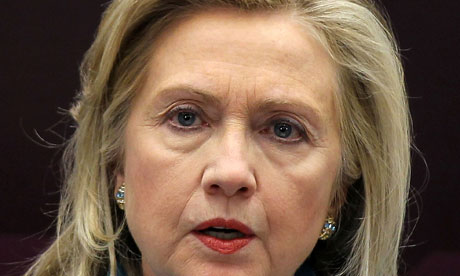
Hillary Clinton calls on countries to sanction Syria

US wants nations with close economic links to Bashar al-Assad's regime to follow it to sanction Syria's oil and gas industry
The US secretary of state, Hillary Clinton, has called on other nations with closer economic links to Syria to join it in sanctions on Bashar al-Assad's regime.

She said Washington had been "very clear" in its statements about Assad's loss of legitimacy but the "real trick" was to convince "the Europeans and the Arabs and the Chinese and the Indians and others" to do more.

"We're going to sanction and we have been upping the sanctions. We're going to continue to do so," she said. "But we want others to follow, because Syria was not one of our major economic partners."

Clinton said it was necessary to sanction Syria's oil and gas industry.

A security crackdown has been ongoing in Syria since the start of Ramadan 11 days ago. Security forces killed at least 10 more people on Thursday as the raids and repression continued.

Mass demonstrations are expected across the country on Friday – the "day of not kneeling". A Facebook group, the Syrian Revolution 2011, said in a defiant message: "We only kneel before God."

Wednesday, August 10, 2011

U.S. could call for Al-Assad for violence in Syria

The international cries for Syria's government to end a bloody crackdown on civilians could intensify Wednesday as activist groups reported fresh onslaughts in several cities.

The United Nations Security Council is expected today to follow up on a statement last week that condemned the Syrian regime for attacks on peaceful protesters and called for both sides to end the violence.

U.S. government sources told, The United States is moving toward issuing an explicit call for Syrian President Bashar al-Assad to step down.

The move is expected to be announced in coming days after U.S. officials consult with the United Nations Security Council, they said the question of whether to call for al-Assad to step down has been under discussion over the past few weeks.

While international leaders mull their next steps, heavy gunfire, explosions and tanks permeated the eastern city of Deir Ezzor on today.

The observatory said in morning, "There are also large scale arrests in those areas as mobile service and landline communications have been completely cut out in the areas since the start of the military operation."

The conflict in Syria was fueled five months ago when Syrian forces swiftly suppressed protests in the southern city of Daraa.

On Tuesday, Turkish Foreign Minister Ahmet Davutoglu and al-Assad engaged in more than six hours of talks in Damascus.

Davutoglu told, "Our primary target is the bloodshed to stop,". "We shared what needs to be done for the bloodshed to stop, for the civilian losses to end and for the political reform process, in line with the people's demands, to take place."

Al-Assad told Davutoglu that his country won't relent in chasing down the "armed terrorist groups" it blames for the violence that has engulfed the nation.

Al-Assad briefed Davutoglu on the killing and terrorizing in some Syrian cities by the purported groups. At the same time, he indicated that Syria is committed to reform and is open to help from other countries.

Russia called on the Syrian government Tuesday "to stop the violence and to introduce deep political changes," the Russian Foreign Ministry.

A Saudi Arabia's King Abdullah has condemned violence in Syria in a rare rebuke directed at a fellow Arab leader, who leads a majority Sunni Muslim nation with a government dominated by minority Alawites, whose faith is a spinoff of Shiite Islam. Abdullah demanded an end "to the killing machine and the bloodshed."

"A mere diplomatic appeal to the Syrian authorities to end the ongoing violence against civilians will fall far short of what the situation demands."

Saturday, August 6, 2011

U.S. Urges Citizens to Leave Syria 'Immediately'

The United States urged U.S. citizens Friday to depart Syria "immediately," and noted that the Damascus government has placed "severe" constraints on the travel of U.S. diplomats in the country.

The latest travel warning said, "The U.S. Department of State urges U.S. citizens in Syria to depart immediately while commercial transportation is available."

He warning, an update to an April 25 order for US embassy staff's family members and some non-emergency personnel to leave Syria, expressed growing concern over the violent crackdown by President Bashar al Assad's security forces against pro-democracy protesters.

Last month, pro-government demonstrators attacked the U.S. and French embassies in Damascus, smashing windows and spray-painting walls after the two Western envoys visited the flashpoint protest city of Hama.

Washington sent its ambassador back to Damascus on Thursday as it gradually cranked up the heat on Assad. Robert Ford had infuriated the Assad regime with his visit to Hama last month, but he has vowed to continue traveling around the country. French Ambassador Eric Chevallier also visited the city on July 7.

Syria responded by imposing a ban on the two envoys prohibiting them from traveling outside Damascus.

Noting that Syrian demonstrations have been "violently suppressed" since March, the State Department warned U.S. citizens that "demonstrations can occur with little or no warning anytime and anywhere, not just on Friday afternoons, as with many past demonstrations."

"U.S. citizens are urged to avoid the areas of demonstrations if possible, and to exercise caution if within the vicinity of a demonstration."

"Syrian efforts to attribute the current civil unrest to external influences may lead to an increase in anti-foreigner sentiment," the State Department warned.. "Detained U.S. citizens may find themselves subject to allegations of incitement or espionage."

It said Syrian authorities often do not notify the U.S. embassy of a U.S. citizen's arrest until days or weeks later, and decline requests for consular access.